This page has been translated via machine translation. Please refer to the original version in English and consult Eurofound's language policy.
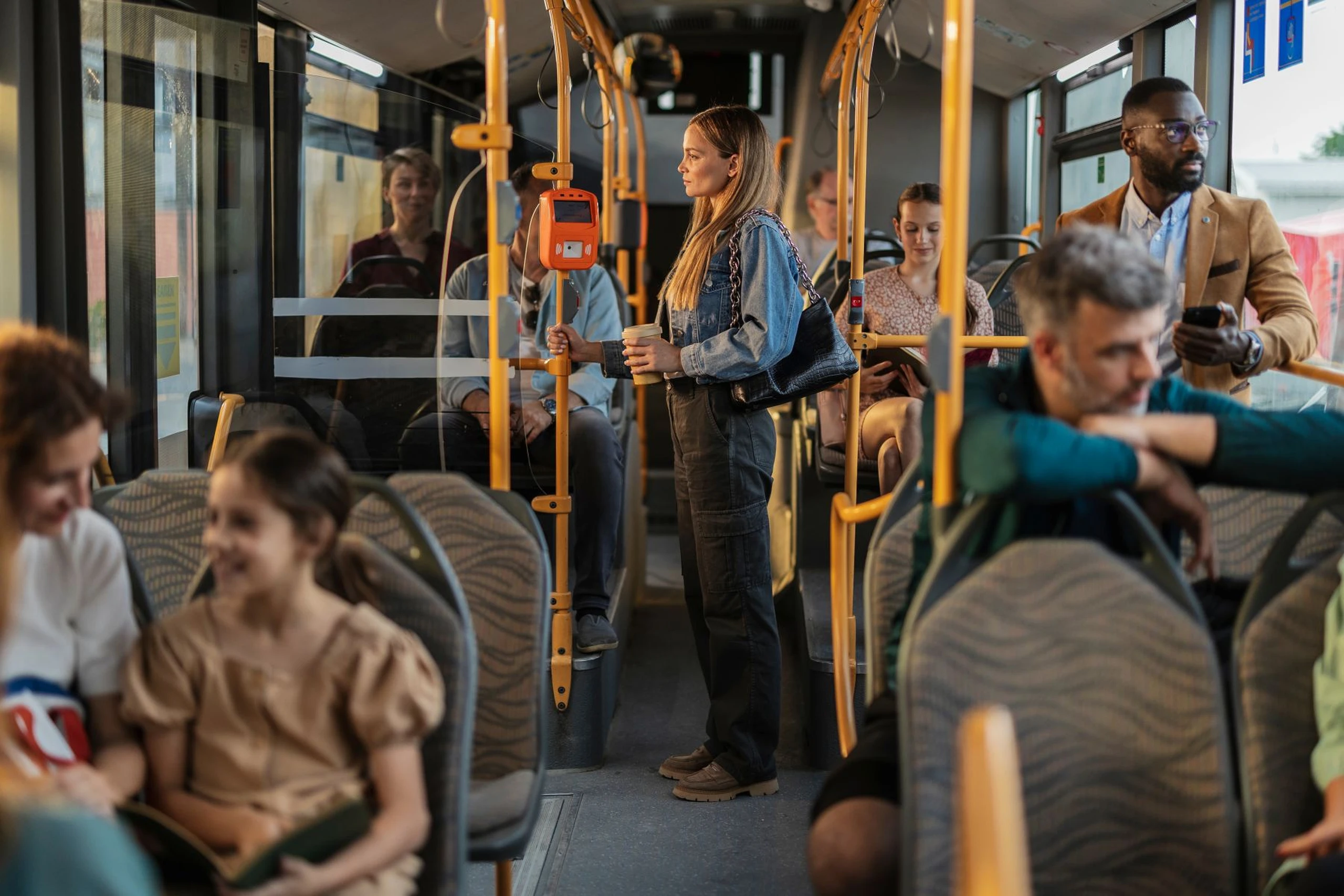
People ride a city bus; a woman stands holding a pole and coffee while other passengers sit, talk, and use phones.
Research report
New
Published: 19 November 2026

Delivering on the promise of leaving no one behind: Ensuring a just green transition for EU citizens

Data: 33 figures and 16 tables

The European Green Deal commits to leaving no one behind, but whether climate policy delivers on that promise depends on how individual measures are designed and received. This report examines the extent to which that promise has been kept for people and households across the EU, combining survey evidence on attitudes and behaviour with an analysis of over 150 national policy measures related to energy-efficient housing and green mobility. The findings show that financial security, institutional trust and feelings of political recognition are all associated with engagement in the transition. Conversely, particular constraints on such engagement are faced by rural residents, private renters who have no authority over retrofitting decisions, low-income households unable to meet upfront costs and digitally excluded citizens.

Please note that most Eurofound publications are available exclusively in English and are not currently machine-translated.

Loading PDF…

  • Climate awareness is high across the EU, but does not always drive green behaviour. Trust in EU institutions and feeling valued and fairly treated by government are the strongest predictors of green behaviour. 

  • The current design of green transition policies risks leaving those with the fewest choices behind. Private renters depend on landlords with little incentive to renovate; rural residents lack viable alternatives to the car; and the most impactful choices remain largely a privilege of wealthier households, with lower-income households being less able to afford greener choices. 

  • Policymakers have ways to make green policies fairer, but their implementation varies across Member States. Automatically linking social assistance records to energy and mobility schemes, pairing minimum energy performance standards with tenant protections and providing upfront grants and tailoring mobility options to rural areas can help support those most in need. 

  • Behavioural insights can help turn climate awareness into action, but their use in policymaking is uneven across the EU. Ireland and the Netherlands have gone furthest in making behavioural insights a systematic and routine part of policymaking across government, while their use is well established but less widespread in Austria, Belgium, Denmark, Finland and France. 

  • The green transition needs to be fair as well as effective. With the Social Climate Fund now operating and the new emissions trading system for buildings and road transport approaching, it is critical that policymakers regularly assess who bears the costs, who benefits and who risks being left behind.

Europeans are navigating a period of intersecting pressures, experiencing the direct impacts of climate change while simultaneously adapting to fundamental shifts in how they live, move and consume. These changes in how they live their daily lives are driven by policies designed to accelerate the green transition through fast-approaching, legally binding targets, notably climate neutrality by 2050 and a 55 % reduction in net emissions by 2030, and have been further sharpened by recurring external shocks.

The European Commission has made it clear that accelerating the clean energy transition is both an environmental and a strategic economic imperative. Yet the costs, benefits and disruptions of this transition may not naturally fall equitably across the economy and the population. With this in mind, the commitment that no person and no place should be left behind during the green transition reflects a dual imperative: climate policy must be effective, but it must also be equitable.

This report examines how people are experiencing the just green transition in their daily lives by analysing citizen attitudes, behavioural adaptation and policy reach across two domains: home energy efficiency and green mobility.

The insights from this research come at a pivotal moment for the European Union. The Social Climate Fund began operating in 2026, mobilising over EUR 86.7 billion to support vulnerable people, microenterprises and transport users. The start of the new emissions trading system for buildings and road transport (ETS2) was postponed from 2027 to January 2028, giving EU Member States additional time to prepare without removing the underlying pressure to achieve climate goals. The European Affordable Housing Plan, presented on 16 December 2025, reinforces the Renovation Wave Strategy’s ambition to deliver 35 million renovated buildings by 2030. An integrated framework for European climate resilience and risk management is scheduled for adoption in late 2026.

These instruments are now operating in a context of renewed disruption in the energy market. In response to the fossil energy crisis triggered by the escalation of conflict in the Middle East, the Commission’s AccelerateEU package, presented in early 2026, combines short-term measures to shield households and industries from price shocks with a renewed push to accelerate the shift to clean, homegrown energy.

It builds on the Clean Energy Investment Strategy adopted in March 2026 and reflects the Commission’s view that reducing fossil fuel dependence is now both a climate imperative and a matter of immediate concern in terms of household and economic security.

  • Climate awareness is high across the EU, but does not necessarily or uniformly translate into action. While 85 % of people in the EU consider climate change a serious problem and 84 % recognise its roots in human activity, only 59 % report taking any personal climate action.

  • Unsurprisingly, incentive-based policies enjoy markedly broader public support than restrictive measures: nearly 89 % of respondents to Eurofound’s Living and Working in the EU e-survey support at least one incentive-based policy, compared with 56 % for restrictive ones. The gap widens among financially vulnerable respondents.

  • Beyond income, attitudinal and relational factors are the strongest predictors of support for green policy. Citizens who trust EU institutions and those who feel seen, valued and fairly treated by their governments are significantly more likely to adopt green behaviours and endorse climate initiatives.

  • Deep retrofits, designed to drastically increase energy efficiency in a home, are very rare, and private renters are at risk of being left behind. There is considerable untapped potential for meaningful energy savings. Renters, who account for 32 % of the EU population, are at severe risk of being left behind due to the ‘split-incentive’ problem.

  • Rural and low-income populations face structural mobility barriers. Rural residents are heavily car-dependent and lack access to denser public transport and cycling infrastructure, making them less likely to adopt green mobility changes (52 % vs 65 % for urban dwellers). Furthermore, high-impact changes like purchasing an electric vehicle remain a privilege of wealthier households, while low-income groups rely strictly on low-cost shifts like walking or public transport.

  • Many existing climate schemes favour those who are wealthy, tech-savvy and property owners. Strict digital application processes, ‘first come, first served’ models and programmes requiring households to cover upfront costs out of pocket systematically lock out the lowest-income and most vulnerable citizens.

  • Policy design should be mindful of unintended exclusion traps. Some current schemes favour some groups, while excluding others. This should be addressed head-on, following best-practice examples from across the EU.

  • Wherever possible, the administrative burden should be removed from vulnerable citizens by automatically linking administrative databases – such as social assistance records – to energy efficiency and mobility programmes, so that support reaches those most in need.

  • The offerings of local ‘one-stop shops’ should be expanded, with dedicated in-person assistance to help digitally excluded citizens apply for grants and navigate the practicalities of participation in the transition. Proactive outreach should also be standard practice.

  • Policymakers should target the tenant–landlord divide in such a manner that tenants are shielded from rent increases or evictions, while landlords can recoup, in time, the cost of renovations. This could be achieved through a combination of policy instruments, such as minimum energy performance standards, public subsidies and energy-bill-neutral rent adjustments.

  • Policymakers should consider shifting away from post-payment reimbursement models. More generous upfront grants, pre-financing arrangements and point-of-sale discounts should be considered to overcome the liquidity problem that prevents many households from participating in the green transition.

  • Territorial specificities should be considered carefully. Urban solutions cannot be transposed to rural settings. Policymakers should invest in tailored alternatives, such as demand-responsive and shared transport services; integrate mobility planning with access to essential services; and ensure that rural and peri-urban residents are not disproportionately exposed to the costs of carbon pricing without viable alternatives.

  • More broadly, policymakers should make intentional investments in protecting and nourishing institutional trust and political recognition, as these are both the foundations of effective policy and the outcomes of policy acceptance.

  • Policymakers should incorporate behavioural approaches and instruments into their policymaking toolkit as a complement to conventional instruments. This will enable the bridging of the value–action gap that separates citizens’ stated pro-environmental values from their everyday choices.

  • Strengthening evaluation and monitoring of distributional reach should also be a focus for policymakers. Current reporting frameworks focus on budgetary and output metrics, while a systematic assessment of which people and places are actually being reached is a precondition for effective evaluation and for course correction.

This section provides information on the data contained in this publication.

33 figures related to this publication are available for preview.

The table related to this publication is available for preview.

Eurofound recommends citing this publication in the following way.

Eurofound (2026), Delivering on the promise of leaving no one behind: Ensuring a just green transition for EU citizens, Publications Office of the European Union, Luxembourg.
Flag of the European UnionThis website is an official website of the European Union.
European Foundation for the Improvement of Living and Working Conditions
The tripartite EU agency providing knowledge to assist in the development of better social, employment and work-related policies

All official European Union website addresses are in the europa.eu domain.

See all EU institutions and bodies