&w=3840&q=90)
Job quality
Job quality refers to the extent to which a job’s characteristics support workers’ health, well-being and sustainable participation in work over a period of time. Eurofound’s job quality framework defines the different dimensions of job quality as: physical work environment, work intensity, working time, social environment, skills and discretion, career prospects and earnings. The seven dimensions bring together indicators of job resources and job demands.
Job quality is a multidimensional concept: different research disciplines and policy perspectives can emphasise different dimensions. It can be used alongside measures of job quantity to provide a more complete picture of employment strategies and labour market outcomes.
Find the latest content on this topic below.
Breaking the cycle: Can improving job quality solve the EU’s labour shortages?
Across the EU, labour shortages affect nearly all occupations identified, especially those facing challenging work environments and poor working time quality. By pinpointing job quality gaps linked to health and wellbeing, policymakers and employers can make these jobs more attractive and break the shortage cycle.IT sector in focus: Evolution of the EU’s digital workforce
The ICT sector is driving digitalisation and AI adoption across Europe, yet skilled labour shortages are holding back its growth. This report examines employment and working conditions for ICT specialists and the challenges shaping one of the EU's most critical sectors.Algorithmic management in European workplaces: Implications for work organisation and working conditions
This study presents a secondary analysis of data from Eurofound’s Seventh European Working Conditions Survey (EWCS 2024) that explores the prevalence of digital technologies in modern workplaces and the spread of algorithmic management practices. By linking workers’ reported exposure to computer programmes that monitor performance, allocate tasks, and schedule work with indicators of job quality, the analysis assesses how technology reshapes work. It also identifies distinct worker profiles based on patterns of digital technology use and the characteristics associated with each profile. The findings will inform policymaking aimed at promoting high-quality jobs in increasingly digital workplaces.Eurofound aims to consolidate the position of its European Working Conditions Survey (EWCS) as an important tool for benchmarking job quality in the European Union and beyond, feeding into policy development in the area of quality of work. The data have been used to carry out further research on various topics linked to job quality, including job quality in different work situations, job quality of different groups in the labour market, the impact of job quality on quality of working lives and in-depth analysis of individual dimensions of job quality. The European Company Surveys (ECS) also looks at different dimensions of job quality for workers and employers. Recent research has also looked into job quality in a global perspective.
Job quality and its improvement is an important policy concern, as quality jobs are crucial for higher labour force participation, higher well-being and increased economic performance. Job quality is also a key component in making work sustainable and enabling workers to remain motivated to remain in work for longer. It is central to the ILO’s Decent Work Agenda, the OECD’s jobs strategy and to the European Union’s quality of work policies to create more and better jobs. For workers, for the enterprises and organisations that employ them and for societies, there are benefits associated with high-quality jobs, and costs associated with poor-quality jobs.
On 4 December 2025, the European Commission published its Quality Jobs Roadmap which aims to ensure fair wages, good working conditions, future-oriented education and skills, and fair labour mobility for workers and self-employed people. This initiative supports the drive to strengthen the EU’s competitiveness as outlined in the Competitiveness Compass and to create and maintain quality jobs across the Union. At the same time, the Commission launched a first-stage consultation of the social partners on the forthcoming Quality Jobs Act which runs until 29 January 2026.
European Commission: Commission sets out roadmap for future-proof quality jobs in a competitive EUopens in new tab
Commission priority: Supporting people, strengthening our societies and our social modelopens in new tab
International Labour Organization (ILO): Decent workopens in new tab
Organization for Economic Co-operation and Development (OECD): OECD Jobs Strategyopens in new tab
European Commission: European employment strategyopens in new tab
This is a selection of the most important outputs for this topic.
3 September 2025
Trends in job quality: EWCS 2024 first findings

30 June 2024
Job quality side of climate change
Workers will experience the effects of climate change in many ways: job insecurity, changes to their work tasks and responsibilities, and changes in their workplaces that may involve different work practices and the development of new activities and products. Climate change risks are associated with increased exposure to hazards, leading to lower standards of job quality, productivity loss and greater job and work insecurity. Nearly half of workers in the EU will experience profound changes in their job tasks as economies adapt to climate change and climate mitigation strategies are implemented. In addition, work is likely to change as a result of company responses to climate change. These changes in work, while increasing the vulnerability of some workers, offer opportunities to improve some dimensions of job quality. This report outlines the complex relationship between job quality and climate change, including the implication of green tasks in selected sectors.

30 January 2024
Self-employment in the EU: Job quality and developments in social protection
Ensuring greater social protection for self-employed people has been the subject of much policy debate in recent years. In 2019, the Council of the European Union adopted a recommendation on access to social protection for workers and the self-employed. Sudden reductions in income during the COVID-19 pandemic highlighted the vulnerability of many self-employed workers. Using data from the European Working Conditions Telephone Survey, this report examines the working conditions of different groups of self-employed people. It analyses measures taken at EU Member State level to better protect self-employed individuals against the risks of unemployment, workplace accidents and sickness, and presents lessons learned from measures implemented during the pandemic.

9 October 2023
Job quality of COVID-19 pandemic essential workers
During the COVID-19 pandemic, a diverse collection of workers ensured the functioning of our societies. In a time of crisis, they maintained access to healthcare, long-term care and other essential goods and services, including food, water, electricity, the internet and waste treatment. These were the COVID-19 pandemic essential, or critical, workers, many of whom risked their physical and mental health by continuing to go to work during the pandemic.
This policy brief investigates the job quality of these critical workers, making use of unique sources of information, including data from the European Working Conditions Telephone Survey 2021, data gathered by correspondents from across the Member States and interviews with EU-level social partner representatives from selected sectors. It examines the experiences of work among critical workers during the pandemic, and highlights imminent challenges to the sustainability of their work. The aim is to discover whether these workers are equipped to support society through future shocks and crises.

26 February 2021
Working conditions and sustainable work: An analysis using the job quality framework
This flagship report summarises the key findings of Eurofound’s research on working conditions conducted over the programming period 2017–2020. It maps the progress achieved since 2000 in improving working conditions and examines whether all workers have benefited equally from positive change. It highlights which groups are the most at risk of experiencing poor working conditions and being left behind. Given the changes in the world of work, emerging challenges for good job quality are identified. The report also provides evidence for measures that could lead to the further improvement of work and the achievement of fair working conditions for all in the EU. The analysis shows that, overall, job quality in the EU is improving, if slowly. Not all workers are benefiting to the same extent, however. Furthermore, gender, age and contractual status have a significant bearing on a person’s working conditions. And while digitalisation helps to address some job quality issues, it also creates new challenges. The COVID-19 pandemic has exacerbated trends, reinforcing concerns and highlighting the importance of achieving job quality for all.

2 March 2020
Gender equality at work
Gender inequality at work persists across Europe, despite the long standing attention paid and efforts made to tackle it. This Eurofound report presents a closer look at women’s and men’s working conditions, using data from Eurofound’s European Working Conditions Survey (EWCS) and complementing previous Eurofound research on, among other things, working time patterns, work–life balance and workers’ health. Beyond the general differences in the labour market, it highlights many important gaps in men’s and women’s working conditions and job quality which require specific attention. According to the EWCS data, the reduction of gender gaps in those areas showing improvement over the last 5 to 10 years remains limited. European and national strategies aimed at achieving job quality for all, that seek to mainstream gender equality, could help address persistent inequalities between men and women.

12 October 2020
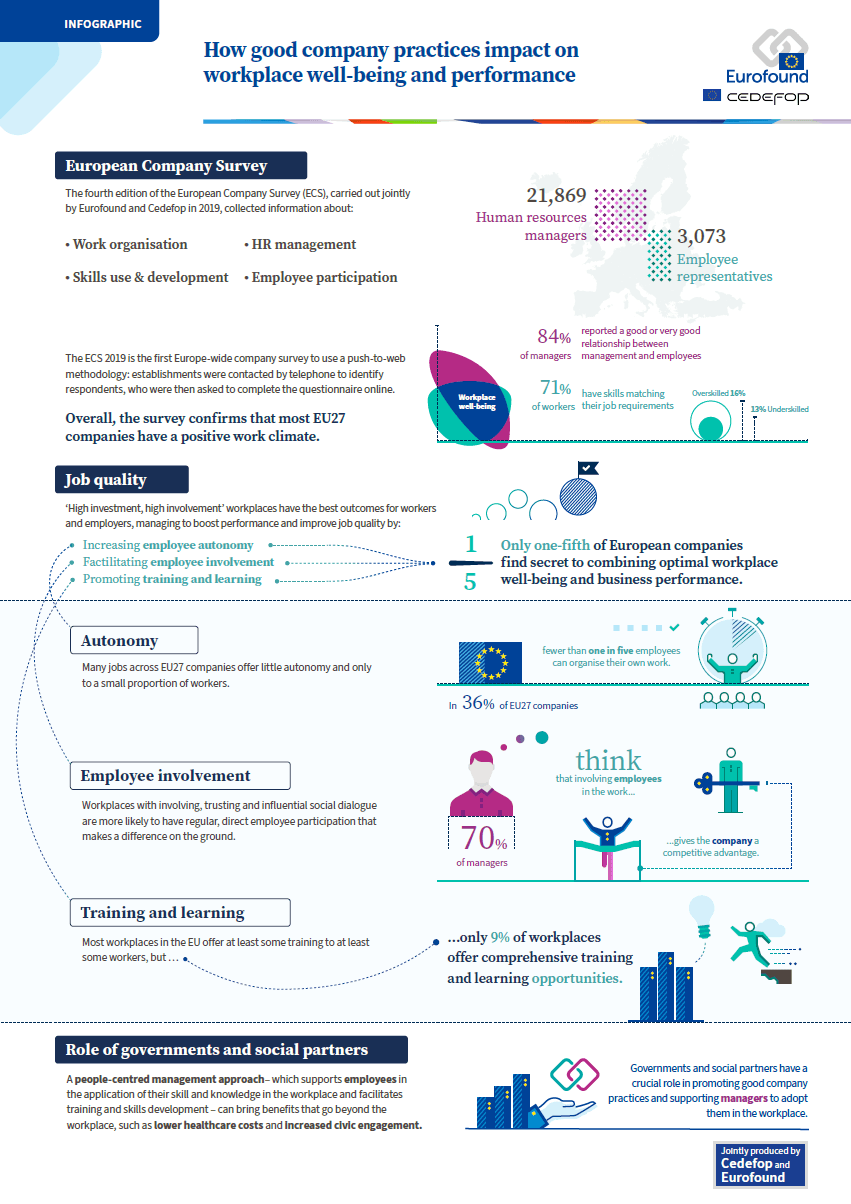
European Company Survey 2019 - Workplace practices unlocking employee potential
This report is based on the fourth edition of the European Company Survey (ECS), which was carried out jointly by Eurofound and Cedefop in 2019. It describes a wide range of practices and strategies implemented by European companies in terms of work organisation, human resource management, skills use and skills development, and employee voice. The report shows how these practices are combined and how the resulting ‘bundles of practices’ are associated with two outcomes beneficial to employees and employers: workplace well-being and establishment performance.
The analysis finds that the establishments that are most likely to generate this win–win outcome are those that combine a high degree of worker autonomy, a balanced motivational strategy, a comprehensive training and learning strategy, and high levels of direct employee involvement in decision-making, as well as offering managerial support for these practices. To boost the adoption of employee-oriented practices – particularly in relation to autonomy, skills and employee involvement – managers should be offered appropriate support, as they play a key role in the decision to initiate workplace change. They are also crucial to its success, as they must continuously support the workplace practices implemented.

6 May 2019
Working conditions in a global perspective
Job quality is a major focus of policymakers around the world. For workers, the enterprises that employ them and for societies, there are benefits associated with high-quality jobs, and costs associated with poor-quality jobs. This report – the result of a pioneering project by the International Labour Organization and Eurofound – provides a comparative analysis of job quality covering approximately 1.2 billion workers in Europe, Asia and the Americas. It analyses seven dimensions of job quality: the physical environment, work intensity, working time quality, the social environment, skills and development, prospects, and earnings, finding both important differences and similarities between countries. By analysing positive and negative aspects of job quality in different countries and societies, the report provides a way to look beyond national explanations, to see how some groups of workers are affected more than others and understand the particular issues for women workers around the world – in support of evidence-based policymaking to improve job quality.

17 November 2016
Sixth European Working Conditions Survey – Overview report

Researchers at Eurofound provide expert insights and can be contacted for questions or media requests.
Jorge Cabrita
Senior research managerJorge Cabrita is a senior research manager in the Working Life unit, where he designs, coordinates, and manages Europe-wide research and disseminates its findings. His main areas of expertise include working conditions and job quality, working time and work–life balance, workers’ health and well-being, gender equality, and the socioeconomic impacts of the green transition. He currently leads research on working time developments and job quality in climate-vulnerable regions, and co-leads the implementation of the European Working Conditions Survey 2030. Previously, he was a researcher at the Centre for Studies for Social Intervention and the Research Centre on the Portuguese Economy, and worked as a trainer and consultant. He holds a BSc in Economics and an MSc in Socio-Organisational Systems of Economic Activity from the Lisbon School of Economics.
Agnès Parent-Thirion
Senior research managerAgnès Parent-Thirion is a senior research manager in the Working Life unit at Eurofound, overseeing the planning and development of working conditions research. She plays a key role in the European Working Conditions Survey (EWCS), co-leading the preparation of and leading the questionnaire development for EWCS 2030. Her research interests include job quality, work organisation, gender, psychosocial risks and the impact of the green and digital transitions on working life. With over two decades of experience working on European comparative surveys, Agnès specialises in questionnaire development, coding of occupations, quality control and analysis. She is a graduate in economics and management from Paris IX Dauphine and Paris I Panthéon Sorbonne universities and holds a Postgraduate Diploma in Statistics from Trinity College Dublin. She has also completed specialised training on AI leadership (MIT Sloan Executive Education) and the major challenges of transition (Campus de la Transition). Before joining Eurofound, she worked for a number of years in the European Commission.
This section provides access to all content that has been published on the topic.


