&w=3840&q=90)
Qualität der Arbeit
Die Arbeitsplatzqualität ergänzt die Messungen der Arbeitsplatzquantität, um eine Bewertung der Beschäftigungsstrategie zu ermöglichen. Arbeitsplatzqualität ist ein mehrdimensionales Konzept, bei dem unterschiedliche politische Agenden und Disziplinen unterschiedliche Dimensionen betonen. In den meisten Forschungsarbeiten von Eurofound wird die Arbeitsplatzqualität auf der Ebene des Arbeitsplatzes gemessen. Es umfasst Berufsmerkmale, die aus einer objektiven Perspektive erfasst werden, die beobachtet werden können und mit der Erfüllung der Arbeitsbedürfnisse der Menschen in Verbindung stehen. Sie setzt sich aus allen Merkmalen von Arbeit und Beschäftigung zusammen, die nachweislich einen kausalen Zusammenhang mit Gesundheit und Wohlbefinden haben. Positive und negative Aspekte der Jobs werden einbezogen. Diese Indikatoren spiegeln die beruflichen Ressourcen (physische, psychische, soziale oder organisatorische Aspekte) und die Arbeitsanforderungen oder die Prozesse, die sie beeinflussen, wider.
Nachfolgend finden Sie die neuesten Inhalte zu diesem Thema.
Den Kreislauf durchbrechen: Kann eine Verbesserung der Arbeitsqualität die Arbeitskräfteknappheit in der EU lösen?
In der gesamten EU betreffen Arbeitskräftemangel nahezu alle identifizierten Berufe, insbesondere solche mit schwierigen Arbeitsumgebungen und schlechter Arbeitszeitqualität. Indem sie Arbeitsqualitätslücken im Zusammenhang mit Gesundheit und Wohlbefinden identifizieren, können politische Entscheidungsträger und Arbeitgeber diese Arbeitsplätze attraktiver machen und den Mangel durchbrechen.IT-Sektor im Fokus: Entwicklung der digitalen Arbeitskräfte der EU
Der IKT-Sektor treibt die Digitalisierung und die Einführung von KI in ganz Europa voran, doch der Mangel an qualifizierten Arbeitskräften bremst sein Wachstum. Dieser Bericht untersucht Beschäftigungs- und Arbeitsbedingungen für IKT-Fachkräfte sowie die Herausforderungen, die einen der wichtigsten EU-Sektoren prägen.Algorithmisches Management in europäischen Arbeitsplätzen: Auswirkungen auf die Arbeitsorganisation und Arbeitsbedingungen
Diese Studie präsentiert eine sekundäre Analyse von Daten aus Eurofounds Siebter Europäischen Arbeitsbedingungen-Umfrage (EWCS 2024), die die Verbreitung digitaler Technologien in modernen Arbeitsplätzen und die Verbreitung algorithmischer Managementpraktiken untersucht. Indem die berichtete Exposition der Arbeitnehmer gegenüber Computerprogrammen, die die Leistung überwachen, Aufgaben zuweisen und Arbeit planen, mit Indikatoren der Arbeitsqualität verknüpft, bewertet die Analyse, wie Technologie die Arbeit verändert. Es identifiziert außerdem unterschiedliche Mitarbeiterprofile basierend auf Mustern der Nutzung digitaler Technologien und den mit jedem Profil verbundenen Merkmalen. Die Ergebnisse werden die Politikgestaltung informieren, die darauf abzielt, hochwertige Arbeitsplätze in zunehmend digitalen Arbeitsplätzen zu fördern.Ziel von Eurofound ist es, die Position seiner Europäischen Erhebung über die Arbeitsbedingungen (EWCS) als wichtiges Instrument für das Benchmarking der Arbeitsplatzqualität in der Europäischen Union und darüber hinaus zu festigen und in die Politikentwicklung im Bereich der Arbeitsqualität einfließen zu lassen. Die Daten wurden verwendet, um weitere Forschungsarbeiten zu verschiedenen Themen im Zusammenhang mit der Arbeitsplatzqualität durchzuführen, darunter die Arbeitsplatzqualität in verschiedenen Arbeitssituationen, die Arbeitsplatzqualität verschiedener Gruppen auf dem Arbeitsmarkt, die Auswirkungen der Arbeitsplatzqualität auf die Qualität des Arbeitslebens und eine eingehende Analyse einzelner Dimensionen der Arbeitsplatzqualität. Die Europäischen Unternehmenserhebungen (ECS) befassen sich auch mit verschiedenen Dimensionen der Arbeitsplatzqualität für Arbeitnehmer und Arbeitgeber. Neuere Forschungen haben sich auch mit der Arbeitsplatzqualität in einer globalen Perspektive befasst.
Die Qualität der Arbeitsplätze und ihre Verbesserung ist ein wichtiges politisches Anliegen, da hochwertige Arbeitsplätze für eine höhere Erwerbsbeteiligung, ein höheres Wohlergehen und eine höhere Wirtschaftsleistung von entscheidender Bedeutung sind. Die Arbeitsplatzqualität ist auch eine Schlüsselkomponente, um die Arbeit nachhaltig zu gestalten und die Arbeitnehmer in die Lage zu versetzen, motiviert zu bleiben, länger in Arbeit zu bleiben. Sie ist von zentraler Bedeutung für die ILO-Agenda für menschenwürdige Arbeit, die Beschäftigungsstrategie der OECD und die Politik der Europäischen Union zur Schaffung von mehr und besseren Arbeitsplätzen. Für die Arbeitnehmer, für die Unternehmen und Organisationen, die sie beschäftigen, und für die Gesellschaft gibt es Vorteile, die mit hochwertigen Arbeitsplätzen verbunden sind, und Kosten, die mit minderwertigen Arbeitsplätzen verbunden sind.
Im Jahr 2025 plant die Europäische Kommission, in Zusammenarbeit mit den Sozialpartnern einen Fahrplan für hochwertige Arbeitsplätze vorzulegen, der darauf abzielt, "faire Löhne, gute Arbeitsbedingungen, Ausbildung und faire Arbeitsplatzübergänge für Arbeitnehmer*innen und Selbstständige zu unterstützen. Diese Initiative unterstützt die Bemühungen um die Stärkung der Wettbewerbsfähigkeit der EU, wie sie im Kompass für die Wettbewerbsfähigkeit dargelegt ist, und die Schaffung hochwertiger Arbeitsplätze.
Priorität der Kommission: Unterstützung der Menschen, Stärkung unserer Gesellschaften und unseres Sozialmodellsopens in new tab
Internationale Arbeitsorganisation (ILO): Menschenwürdige Arbeitopens in new tab
Organisation für wirtschaftliche Zusammenarbeit und Entwicklung (OECD): Beschäftigungsstrategie der OECDopens in new tab
Europäische Kommission: Europäische Beschäftigungsstrategieopens in new tab
Dies ist eine Auswahl der wichtigsten Ergebnisse für dieses Thema.
3 September 2025
Trends bei der Arbeitsplatzqualität: Erste Ergebnisse des EBR 2024

30 June 2024
Job quality side of climate change
Workers will experience the effects of climate change in many ways: job insecurity, changes to their work tasks and responsibilities, and changes in their workplaces that may involve different work practices and the development of new activities and products. Climate change risks are associated with increased exposure to hazards, leading to lower standards of job quality, productivity loss and greater job and work insecurity. Nearly half of workers in the EU will experience profound changes in their job tasks as economies adapt to climate change and climate mitigation strategies are implemented. In addition, work is likely to change as a result of company responses to climate change. These changes in work, while increasing the vulnerability of some workers, offer opportunities to improve some dimensions of job quality. This report outlines the complex relationship between job quality and climate change, including the implication of green tasks in selected sectors.

30 January 2024
Self-employment in the EU: Job quality and developments in social protection
Ensuring greater social protection for self-employed people has been the subject of much policy debate in recent years. In 2019, the Council of the European Union adopted a recommendation on access to social protection for workers and the self-employed. Sudden reductions in income during the COVID-19 pandemic highlighted the vulnerability of many self-employed workers. Using data from the European Working Conditions Telephone Survey, this report examines the working conditions of different groups of self-employed people. It analyses measures taken at EU Member State level to better protect self-employed individuals against the risks of unemployment, workplace accidents and sickness, and presents lessons learned from measures implemented during the pandemic.

9 October 2023
Job quality of COVID-19 pandemic essential workers
During the COVID-19 pandemic, a diverse collection of workers ensured the functioning of our societies. In a time of crisis, they maintained access to healthcare, long-term care and other essential goods and services, including food, water, electricity, the internet and waste treatment. These were the COVID-19 pandemic essential, or critical, workers, many of whom risked their physical and mental health by continuing to go to work during the pandemic.
This policy brief investigates the job quality of these critical workers, making use of unique sources of information, including data from the European Working Conditions Telephone Survey 2021, data gathered by correspondents from across the Member States and interviews with EU-level social partner representatives from selected sectors. It examines the experiences of work among critical workers during the pandemic, and highlights imminent challenges to the sustainability of their work. The aim is to discover whether these workers are equipped to support society through future shocks and crises.

26 February 2021
Working conditions and sustainable work: An analysis using the job quality framework
This flagship report summarises the key findings of Eurofound’s research on working conditions conducted over the programming period 2017–2020. It maps the progress achieved since 2000 in improving working conditions and examines whether all workers have benefited equally from positive change. It highlights which groups are the most at risk of experiencing poor working conditions and being left behind. Given the changes in the world of work, emerging challenges for good job quality are identified. The report also provides evidence for measures that could lead to the further improvement of work and the achievement of fair working conditions for all in the EU. The analysis shows that, overall, job quality in the EU is improving, if slowly. Not all workers are benefiting to the same extent, however. Furthermore, gender, age and contractual status have a significant bearing on a person’s working conditions. And while digitalisation helps to address some job quality issues, it also creates new challenges. The COVID-19 pandemic has exacerbated trends, reinforcing concerns and highlighting the importance of achieving job quality for all.

2 March 2020
Gender equality at work
Gender inequality at work persists across Europe, despite the long standing attention paid and efforts made to tackle it. This Eurofound report presents a closer look at women’s and men’s working conditions, using data from Eurofound’s European Working Conditions Survey (EWCS) and complementing previous Eurofound research on, among other things, working time patterns, work–life balance and workers’ health. Beyond the general differences in the labour market, it highlights many important gaps in men’s and women’s working conditions and job quality which require specific attention. According to the EWCS data, the reduction of gender gaps in those areas showing improvement over the last 5 to 10 years remains limited. European and national strategies aimed at achieving job quality for all, that seek to mainstream gender equality, could help address persistent inequalities between men and women.

12 October 2020
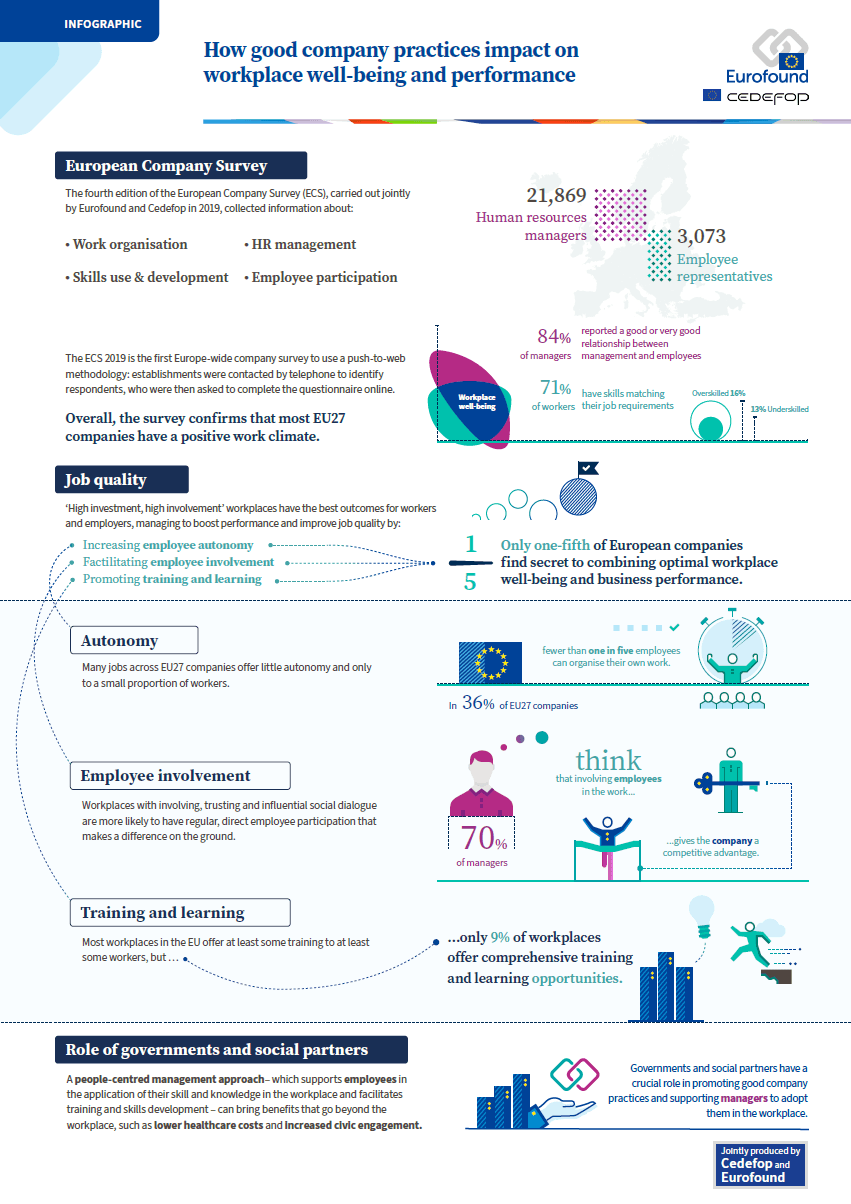
European Company Survey 2019 - Workplace practices unlocking employee potential
This report is based on the fourth edition of the European Company Survey (ECS), which was carried out jointly by Eurofound and Cedefop in 2019. It describes a wide range of practices and strategies implemented by European companies in terms of work organisation, human resource management, skills use and skills development, and employee voice. The report shows how these practices are combined and how the resulting ‘bundles of practices’ are associated with two outcomes beneficial to employees and employers: workplace well-being and establishment performance.
The analysis finds that the establishments that are most likely to generate this win–win outcome are those that combine a high degree of worker autonomy, a balanced motivational strategy, a comprehensive training and learning strategy, and high levels of direct employee involvement in decision-making, as well as offering managerial support for these practices. To boost the adoption of employee-oriented practices – particularly in relation to autonomy, skills and employee involvement – managers should be offered appropriate support, as they play a key role in the decision to initiate workplace change. They are also crucial to its success, as they must continuously support the workplace practices implemented.

6 May 2019
Working conditions in a global perspective
Job quality is a major focus of policymakers around the world. For workers, the enterprises that employ them and for societies, there are benefits associated with high-quality jobs, and costs associated with poor-quality jobs. This report – the result of a pioneering project by the International Labour Organization and Eurofound – provides a comparative analysis of job quality covering approximately 1.2 billion workers in Europe, Asia and the Americas. It analyses seven dimensions of job quality: the physical environment, work intensity, working time quality, the social environment, skills and development, prospects, and earnings, finding both important differences and similarities between countries. By analysing positive and negative aspects of job quality in different countries and societies, the report provides a way to look beyond national explanations, to see how some groups of workers are affected more than others and understand the particular issues for women workers around the world – in support of evidence-based policymaking to improve job quality.

17 November 2016
Sixth European Working Conditions Survey – Overview report

Die Forschenden von Eurofound bringen ihr Fachwissen ein und stehen für Fragen und Medienanfragen zur Verfügung.
Jorge Cabrita
Senior research managerJorge Cabrita ist leitender Forschungsleiter in der Working Life Unit, wo er europaweite Forschung entwirft, koordiniert und leitet sowie deren Ergebnisse verbreitet. Seine Hauptfachgebiete umfassen Arbeitsbedingungen und Arbeitsqualität, Arbeitszeit und Work-Life-Balance, Gesundheit und Wohlbefinden der Arbeitnehmer, Geschlechtergleichstellung sowie die sozioökonomischen Auswirkungen des grünen Übergangs. Derzeit leitet er Forschung zu Entwicklungen der Arbeitszeit und der Arbeitsqualität in klimagefährdeten Regionen und leitet gemeinsam die Umsetzung der European Working Conditions Survey 2030. Zuvor war er Forscher am Centre for Studies for Social Intervention und am Research Centre on the Portuguese Economy und arbeitete als Ausbilder und Berater. Er hat einen BSc in Wirtschaftswissenschaften und einen MSc in Sozio-Organizational Systems of Economic Activity von der Lisbon School of Economics.
Agnès Parent-Thirion
Senior research managerAgnès Parent-Thirion ist leitende Forschungsleiterin in der Working Life Unit bei Eurofound und überwacht die Planung und Entwicklung der Forschung zu Arbeitsbedingungen. Sie spielt eine Schlüsselrolle in der European Working Conditions Survey (EWCS) und leitet gemeinsam die Vorbereitung und Entwicklung des Fragebogens für EWCS 2030. Ihre Forschungsinteressen umfassen Arbeitsqualität, Arbeitsorganisation, Geschlecht, psychosoziale Risiken sowie die Auswirkungen von grünen und digitalen Übergängen auf das Arbeitsleben. Mit über zwei Jahrzehnten Erfahrung in europäischen vergleichenden Umfragen spezialisiert sich Agnès auf Fragebogenentwicklung, Codierung von Berufen, Qualitätskontrolle und Analyse. Sie hat einen Abschluss in Volkswirtschaft und Management von den Universitäten Paris IX Dauphine und Paris I Panthéon Sorbonne und besitzt ein Postgraduiertendiplom in Statistik vom Trinity College Dublin. Sie hat außerdem spezialisierte Ausbildungen zu KI-Führung (MIT Sloan Executive Education) und den großen Herausforderungen des Übergangs (Campus de la Transition) absolviert. Bevor sie zu Eurofound kam, arbeitete sie mehrere Jahre in der Europäischen Kommission.
Dieser Abschnitt bietet Zugriff auf alle Inhalte, die zu diesem Thema veröffentlicht wurden.