&w=3840&q=90)
Ποιότητα εργασίας
Η ποιότητα των θέσεων εργασίας συμπληρώνει τα μέτρα της ποσότητας των θέσεων εργασίας για την αξιολόγηση της στρατηγικής απασχόλησης. Η ποιότητα των θέσεων εργασίας είναι μια πολυδιάστατη έννοια όπου διαφορετική πολιτική ατζέντα και κλάδοι δίνουν έμφαση σε διαφορετικές διαστάσεις. Στο μεγαλύτερο μέρος της έρευνας του Eurofound, η ποιότητα των θέσεων εργασίας μετράται στο επίπεδο της εργασίας. Περιλαμβάνει χαρακτηριστικά εργασίας που συλλαμβάνονται από αντικειμενική προοπτική, τα οποία μπορούν να παρατηρηθούν και σχετίζονται με την κάλυψη των αναγκών των ανθρώπων από την εργασία. Αποτελείται από όλα τα χαρακτηριστικά της εργασίας και της απασχόλησης που έχουν αποδειχθεί ότι έχουν αιτιώδη σχέση με την υγεία και την ευημερία. Περιλαμβάνονται θετικά και αρνητικά χαρακτηριστικά των θέσεων εργασίας. Οι δείκτες αυτοί αντικατοπτρίζουν τους πόρους εργασίας (σωματικές, ψυχολογικές, κοινωνικές ή οργανωτικές πτυχές) και τις απαιτήσεις εργασίας ή τις διαδικασίες που τις επηρεάζουν.
Βρείτε το πιο πρόσφατο περιεχόμενο σχετικά με αυτό το θέμα παρακάτω.
Σπάζοντας τον κύκλο: Μπορεί η βελτίωση της ποιότητας των θέσεων εργασίας να λύσει τις ελλείψεις εργατικού δυναμικού στην ΕΕ;
Σε ολόκληρη την ΕΕ, οι ελλείψεις εργατικού δυναμικού επηρεάζουν σχεδόν όλα τα επαγγέλματα που εντοπίζονται, ιδίως εκείνα που αντιμετωπίζουν δύσκολα εργασιακά περιβάλλοντα και κακή ποιότητα χρόνου εργασίας. Εντοπίζοντας τα κενά στην ποιότητα των θέσεων εργασίας που συνδέονται με την υγεία και την ευημερία, οι υπεύθυνοι χάραξης πολιτικής και οι εργοδότες μπορούν να καταστήσουν αυτές τις θέσεις εργασίας πιο ελκυστικές και να σπάσουν τον κύκλο της έλλειψης.Ο τομέας της πληροφορικής στο επίκεντρο: Εξέλιξη του ψηφιακού εργατικού δυναμικού της ΕΕ
Ο τομέας των ΤΠΕ οδηγεί την ψηφιοποίηση και την υιοθέτηση της τεχνητής νοημοσύνης σε ολόκληρη την Ευρώπη, ωστόσο οι ελλείψεις ειδικευμένου εργατικού δυναμικού εμποδίζουν την ανάπτυξή του. Η παρούσα έκθεση εξετάζει τις συνθήκες απασχόλησης και εργασίας για τους ειδικούς ΤΠΕ και τις προκλήσεις που διαμορφώνουν έναν από τους πιο κρίσιμους τομείς της ΕΕ.Αλγοριθμική διαχείριση στους ευρωπαϊκούς χώρους εργασίας: Επιπτώσεις για την οργάνωση της εργασίας και τις συνθήκες εργασίας
Η παρούσα μελέτη παρουσιάζει μια δευτερογενή ανάλυση δεδομένων από την έβδομη ευρωπαϊκή έρευνα για τις συνθήκες εργασίας (EWCS 2024) του Eurofound, η οποία διερευνά την επικράτηση των ψηφιακών τεχνολογιών στους σύγχρονους χώρους εργασίας και τη διάδοση των πρακτικών αλγοριθμικής διαχείρισης. Συνδέοντας την αναφερόμενη έκθεση των εργαζομένων σε προγράμματα υπολογιστών που παρακολουθούν την απόδοση, κατανέμουν εργασίες και προγραμματίζουν την εργασία με δείκτες ποιότητας εργασίας, η ανάλυση αξιολογεί πώς η τεχνολογία αναδιαμορφώνει την εργασία. Προσδιορίζει επίσης διακριτά προφίλ εργαζομένων με βάση τα πρότυπα χρήσης της ψηφιακής τεχνολογίας και τα χαρακτηριστικά που σχετίζονται με κάθε προφίλ. Τα ευρήματα θα ενημερώσουν τη χάραξη πολιτικής με στόχο την προώθηση θέσεων εργασίας υψηλής ποιότητας σε όλο και πιο ψηφιακούς χώρους εργασίας.Στόχος του Eurofound είναι να εδραιώσει τη θέση της Ευρωπαϊκής Έρευνας για τις Συνθήκες Εργασίας (EWCS) ως σημαντικού εργαλείου συγκριτικής αξιολόγησης της ποιότητας των θέσεων εργασίας στην Ευρωπαϊκή Ένωση και πέραν αυτής, τροφοδοτώντας την ανάπτυξη πολιτικής στον τομέα της ποιότητας της εργασίας. Τα δεδομένα χρησιμοποιήθηκαν για τη διεξαγωγή περαιτέρω έρευνας σχετικά με διάφορα θέματα που συνδέονται με την ποιότητα των θέσεων εργασίας, συμπεριλαμβανομένης της ποιότητας των θέσεων εργασίας σε διαφορετικές καταστάσεις εργασίας, της ποιότητας των θέσεων εργασίας των διαφόρων ομάδων στην αγορά εργασίας, του αντίκτυπου της ποιότητας των θέσεων εργασίας στην ποιότητα της επαγγελματικής ζωής και της εις βάθος ανάλυσης των επιμέρους διαστάσεων της ποιότητας των θέσεων εργασίας. Οι έρευνες για τις ευρωπαϊκές επιχειρήσεις (ECS) εξετάζουν επίσης διάφορες διαστάσεις της ποιότητας των θέσεων εργασίας για τους εργαζομένους και τους εργοδότες. Πρόσφατες έρευνες εξέτασαν επίσης την ποιότητα των θέσεων εργασίας σε παγκόσμια προοπτική.
Η ποιότητα των θέσεων εργασίας και η βελτίωσή της αποτελούν σημαντικό μέλημα πολιτικής, καθώς οι ποιοτικές θέσεις εργασίας είναι ζωτικής σημασίας για την υψηλότερη συμμετοχή στο εργατικό δυναμικό, την υψηλότερη ευημερία και την αύξηση των οικονομικών επιδόσεων. Η ποιότητα των θέσεων εργασίας αποτελεί επίσης βασική συνιστώσα για να καταστεί η εργασία βιώσιμη και να δοθεί η δυνατότητα στους εργαζομένους να διατηρήσουν τα κίνητρά τους να παραμείνουν στην εργασία για μεγαλύτερο χρονικό διάστημα. Βρίσκεται στο επίκεντρο της ατζέντας της ΔΟΕ για την αξιοπρεπή εργασία, της στρατηγικής του ΟΟΣΑ για την απασχόληση και των πολιτικών της Ευρωπαϊκής Ένωσης για την ποιότητα της εργασίας για τη δημιουργία περισσότερων και καλύτερων θέσεων εργασίας. Για τους εργαζομένους, για τις επιχειρήσεις και τους οργανισμούς που τους απασχολούν και για τις κοινωνίες, υπάρχουν οφέλη που συνδέονται με θέσεις εργασίας υψηλής ποιότητας και κόστος που συνδέεται με θέσεις εργασίας κακής ποιότητας.
Το 2025, η Ευρωπαϊκή Επιτροπή σχεδιάζει να υποβάλει χάρτη πορείας για ποιοτικές θέσεις εργασίας σε συνεργασία με τους κοινωνικούς εταίρους, με στόχο τη «στήριξη δίκαιων μισθών, καλών συνθηκών εργασίας, κατάρτισης και δίκαιων μεταβάσεων στην εργασία για εργαζομένους και αυτοαπασχολούμενους. Η πρωτοβουλία αυτή στηρίζει την προσπάθεια ενίσχυσης της ανταγωνιστικότητας της ΕΕ, όπως περιγράφεται στον Προσανατολισμό της Ανταγωνιστικότητας, και τη δημιουργία ποιοτικών θέσεων εργασίας.
Προτεραιότητα της Επιτροπής: Στήριξη των πολιτών, ενίσχυση των κοινωνιών μας και του κοινωνικού μας μοντέλουopens in new tab
Διεθνής Οργάνωση Εργασίας (ΔΟΕ): Αξιοπρεπής εργασίαopens in new tab
Οργανισμός Οικονομικής Συνεργασίας και Ανάπτυξης (ΟΟΣΑ): Στρατηγική του ΟΟΣΑ για την απασχόλησηopens in new tab
Ευρωπαϊκή Επιτροπή: Ευρωπαϊκή στρατηγική για την απασχόλησηopens in new tab
Πρόκειται για μια επιλογή των σημαντικότερων αποτελεσμάτων για αυτό το θέμα.
3 September 2025
Τάσεις στην ποιότητα των θέσεων εργασίας: πρώτα πορίσματα της EWCS 2024

30 June 2024
Job quality side of climate change
Workers will experience the effects of climate change in many ways: job insecurity, changes to their work tasks and responsibilities, and changes in their workplaces that may involve different work practices and the development of new activities and products. Climate change risks are associated with increased exposure to hazards, leading to lower standards of job quality, productivity loss and greater job and work insecurity. Nearly half of workers in the EU will experience profound changes in their job tasks as economies adapt to climate change and climate mitigation strategies are implemented. In addition, work is likely to change as a result of company responses to climate change. These changes in work, while increasing the vulnerability of some workers, offer opportunities to improve some dimensions of job quality. This report outlines the complex relationship between job quality and climate change, including the implication of green tasks in selected sectors.

30 January 2024
Self-employment in the EU: Job quality and developments in social protection
Ensuring greater social protection for self-employed people has been the subject of much policy debate in recent years. In 2019, the Council of the European Union adopted a recommendation on access to social protection for workers and the self-employed. Sudden reductions in income during the COVID-19 pandemic highlighted the vulnerability of many self-employed workers. Using data from the European Working Conditions Telephone Survey, this report examines the working conditions of different groups of self-employed people. It analyses measures taken at EU Member State level to better protect self-employed individuals against the risks of unemployment, workplace accidents and sickness, and presents lessons learned from measures implemented during the pandemic.

9 October 2023
Job quality of COVID-19 pandemic essential workers
During the COVID-19 pandemic, a diverse collection of workers ensured the functioning of our societies. In a time of crisis, they maintained access to healthcare, long-term care and other essential goods and services, including food, water, electricity, the internet and waste treatment. These were the COVID-19 pandemic essential, or critical, workers, many of whom risked their physical and mental health by continuing to go to work during the pandemic.
This policy brief investigates the job quality of these critical workers, making use of unique sources of information, including data from the European Working Conditions Telephone Survey 2021, data gathered by correspondents from across the Member States and interviews with EU-level social partner representatives from selected sectors. It examines the experiences of work among critical workers during the pandemic, and highlights imminent challenges to the sustainability of their work. The aim is to discover whether these workers are equipped to support society through future shocks and crises.

26 February 2021
Working conditions and sustainable work: An analysis using the job quality framework
This flagship report summarises the key findings of Eurofound’s research on working conditions conducted over the programming period 2017–2020. It maps the progress achieved since 2000 in improving working conditions and examines whether all workers have benefited equally from positive change. It highlights which groups are the most at risk of experiencing poor working conditions and being left behind. Given the changes in the world of work, emerging challenges for good job quality are identified. The report also provides evidence for measures that could lead to the further improvement of work and the achievement of fair working conditions for all in the EU. The analysis shows that, overall, job quality in the EU is improving, if slowly. Not all workers are benefiting to the same extent, however. Furthermore, gender, age and contractual status have a significant bearing on a person’s working conditions. And while digitalisation helps to address some job quality issues, it also creates new challenges. The COVID-19 pandemic has exacerbated trends, reinforcing concerns and highlighting the importance of achieving job quality for all.

2 March 2020
Gender equality at work
Gender inequality at work persists across Europe, despite the long standing attention paid and efforts made to tackle it. This Eurofound report presents a closer look at women’s and men’s working conditions, using data from Eurofound’s European Working Conditions Survey (EWCS) and complementing previous Eurofound research on, among other things, working time patterns, work–life balance and workers’ health. Beyond the general differences in the labour market, it highlights many important gaps in men’s and women’s working conditions and job quality which require specific attention. According to the EWCS data, the reduction of gender gaps in those areas showing improvement over the last 5 to 10 years remains limited. European and national strategies aimed at achieving job quality for all, that seek to mainstream gender equality, could help address persistent inequalities between men and women.

12 October 2020
European Company Survey 2019 - Workplace practices unlocking employee potential
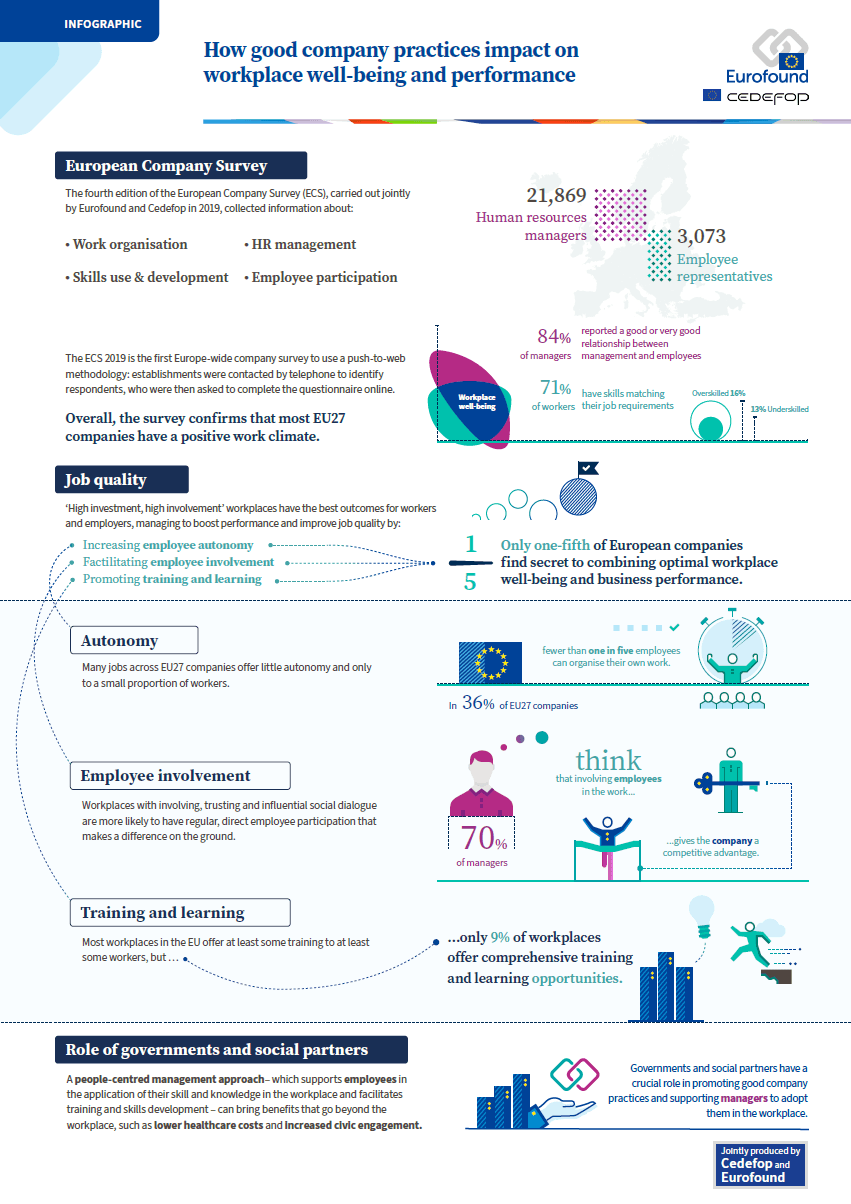
This report is based on the fourth edition of the European Company Survey (ECS), which was carried out jointly by Eurofound and Cedefop in 2019. It describes a wide range of practices and strategies implemented by European companies in terms of work organisation, human resource management, skills use and skills development, and employee voice. The report shows how these practices are combined and how the resulting ‘bundles of practices’ are associated with two outcomes beneficial to employees and employers: workplace well-being and establishment performance.
The analysis finds that the establishments that are most likely to generate this win–win outcome are those that combine a high degree of worker autonomy, a balanced motivational strategy, a comprehensive training and learning strategy, and high levels of direct employee involvement in decision-making, as well as offering managerial support for these practices. To boost the adoption of employee-oriented practices – particularly in relation to autonomy, skills and employee involvement – managers should be offered appropriate support, as they play a key role in the decision to initiate workplace change. They are also crucial to its success, as they must continuously support the workplace practices implemented.

6 May 2019
Working conditions in a global perspective
Job quality is a major focus of policymakers around the world. For workers, the enterprises that employ them and for societies, there are benefits associated with high-quality jobs, and costs associated with poor-quality jobs. This report – the result of a pioneering project by the International Labour Organization and Eurofound – provides a comparative analysis of job quality covering approximately 1.2 billion workers in Europe, Asia and the Americas. It analyses seven dimensions of job quality: the physical environment, work intensity, working time quality, the social environment, skills and development, prospects, and earnings, finding both important differences and similarities between countries. By analysing positive and negative aspects of job quality in different countries and societies, the report provides a way to look beyond national explanations, to see how some groups of workers are affected more than others and understand the particular issues for women workers around the world – in support of evidence-based policymaking to improve job quality.

17 November 2016
Sixth European Working Conditions Survey – Overview report

Οι ερευνητές του Eurofound παρέχουν εξειδικευμένες γνώσεις και μπορείτε να επικοινωνήσετε μαζί τους για ερωτήσεις ή αιτήματα των μέσων ενημέρωσης.
Jorge Cabrita
Senior research managerΟ Jorge Cabrita είναι ανώτερος διευθυντής έρευνας στη μονάδα Working Life, όπου σχεδιάζει, συντονίζει και διαχειρίζεται πανευρωπαϊκή έρευνα και διαδίδει τα ευρήματά της. Οι κύριοι τομείς εξειδίκευσής του περιλαμβάνουν τις συνθήκες εργασίας και την ποιότητα της εργασίας, τον χρόνο εργασίας και την ισορροπία μεταξύ επαγγελματικής και προσωπικής ζωής, την υγεία και την ευημερία των εργαζομένων, την ισότητα των φύλων και τις κοινωνικοοικονομικές επιπτώσεις της πράσινης μετάβασης. Επί του παρόντος ηγείται της έρευνας σχετικά με την εξέλιξη του χρόνου εργασίας και την ποιότητα των θέσεων εργασίας σε ευάλωτες στο κλίμα περιοχές και συν-ηγείται της εφαρμογής της Ευρωπαϊκής Έρευνας για τις Συνθήκες Εργασίας 2030. Προηγουμένως, ήταν ερευνητής στο Κέντρο Μελετών για την Κοινωνική Παρέμβαση και στο Ερευνητικό Κέντρο για την Πορτογαλική Οικονομία και εργάστηκε ως εκπαιδευτής και σύμβουλος. Είναι κάτοχος πτυχίου Οικονομικών και μεταπτυχιακού τίτλου στα Κοινωνικο-Οργανωτικά Συστήματα Οικονομικής Δραστηριότητας από τη Σχολή Οικονομικών Επιστημών της Λισαβόνας.
Agnès Parent-Thirion
Senior research managerΗ Agnès Parent-Thirion είναι ανώτερη διευθύντρια έρευνας στη μονάδα Working Life στο Eurofound, επιβλέποντας τον σχεδιασμό και την ανάπτυξη της έρευνας για τις συνθήκες εργασίας. Διαδραματίζει βασικό ρόλο στην Ευρωπαϊκή Έρευνα για τις Συνθήκες Εργασίας (EWCS), συνεπικεφαλής της προετοιμασίας και της ανάπτυξης ερωτηματολογίων για το EWCS 2030. Τα ερευνητικά της ενδιαφέροντα περιλαμβάνουν την ποιότητα της εργασίας, την οργάνωση της εργασίας, το φύλο, τους ψυχοκοινωνικούς κινδύνους και τον αντίκτυπο της πράσινης και της ψηφιακής μετάβασης στην επαγγελματική ζωή. Με πάνω από δύο δεκαετίες εμπειρίας σε ευρωπαϊκές συγκριτικές έρευνες, η Agnès ειδικεύεται στην ανάπτυξη ερωτηματολογίων, την κωδικοποίηση επαγγελμάτων, τον ποιοτικό έλεγχο και την ανάλυση. Είναι πτυχιούχος οικονομικών και διοίκησης από τα πανεπιστήμια Paris IX Dauphine και Paris I Panthéon Sorbonne και κάτοχος μεταπτυχιακού διπλώματος στη Στατιστική από το Trinity College του Δουβλίνου. Έχει επίσης ολοκληρώσει εξειδικευμένη εκπαίδευση στην ηγεσία της τεχνητής νοημοσύνης (MIT Sloan Executive Education) και στις μεγάλες προκλήσεις της μετάβασης (Campus de la Transition). Πριν από την ένταξή της στο Eurofound, εργάστηκε επί σειρά ετών στην Ευρωπαϊκή Επιτροπή.
Αυτό το τμήμα παρέχει πρόσβαση σε όλο το περιεχόμενο που έχει δημοσιευθεί σχετικά με το θέμα.