&w=3840&q=90)
Salario minimo
Il termine 'salario minimo' si riferisce alla restrizione normativa sulla tariffa minima da dare ai datori di lavoro ai lavoratori. I salari minimi statutari sono regolati da leggi o statuti formali. I salari minimi concordati collettivamente sono stipulati nei contratti collettivi tra sindacati e datori di lavoro. Il termine 'salario minimo nazionale' viene utilizzato quando i paesi hanno una (o più) tariffe base che coprono i lavoratori a livello nazionale. Possono essere sia statutarie che concordate collettivamente.
Trova i contenuti più recenti su questo tema qui di seguito.
Salari minimi in aumento: effetti e lezioni politiche da un decennio di cambiamenti
Questo documento di politica esamina come gli aumenti dei minimi nazionali possano influenzare i livelli salariali dei dipendenti, la disuguaglianza salariale, la contrattazione collettiva e la struttura occupazionale più ampia.Lavori a basso salario: tendenze occupazionali e impatto delle politiche sul salario minimo
Questo rapporto esamina gli effetti a lungo termine delle politiche sul salario minimo sulle strutture occupazionali nell'UE-27 negli ultimi due decenni. Analizza sistematicamente come i cambiamenti nei modelli di occupazione settoriali e occupazionali siano collegati a queste politiche.Salari minimi nel 2026: Revisione annuale
La fissazione del salario minimo in tutta l'UE è diventata un'area politica sempre più dinamica e attentamente osservata, plasmata dalla trasposizione della Direttiva UE sul salario minimo e da un decennio di crescita sostenuta in termini reali delle tariffe statutarie. Questo rapporto esamina le discussioni sulla definizione salariale che si sono svolte negli Stati membri e in Norvegia nel 2025, concentrandosi sui paesi con e senza salario minimo nazionale, sull'interazione tra salari minimi e contrattazione collettiva nei settori a basso salario, e sul ruolo crescente dei valori di riferimento indicativo nella definizione delle decisioni nazionali.Ultimo aggiornamento: 4 September 2026
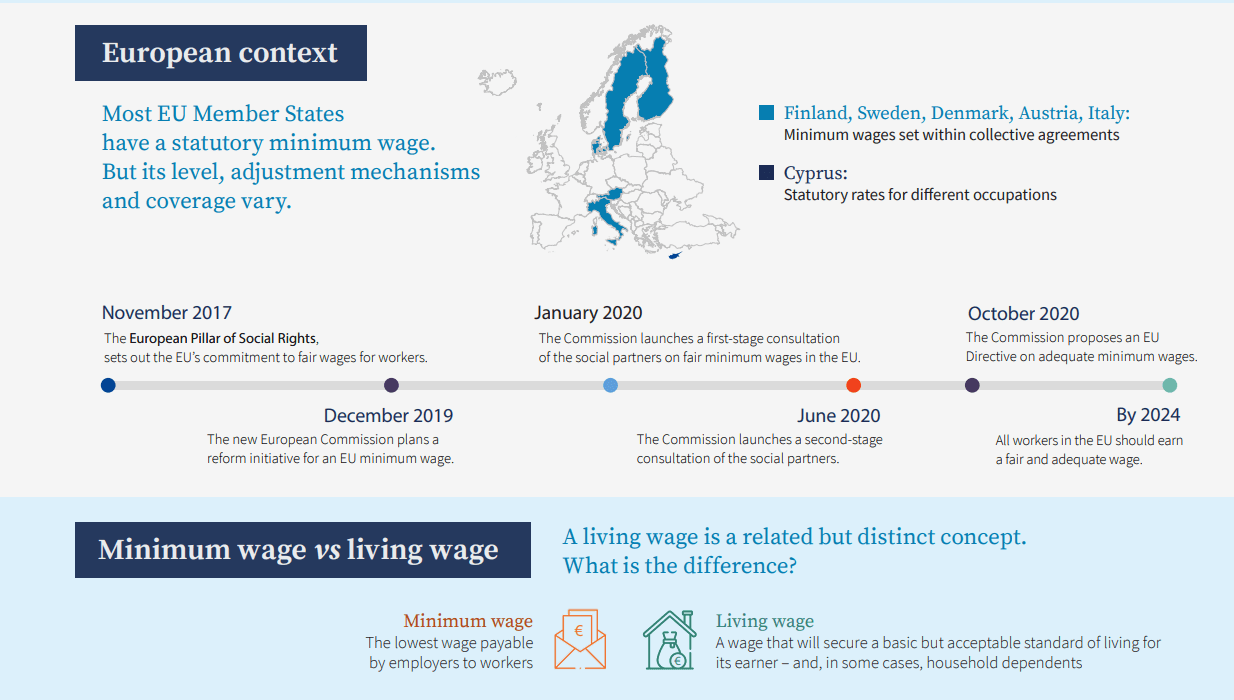
La nostra infografica fornisce ulteriori dettagli sulla situazione attuale al 2020.
Episodio 32Come stanno cambiando i livelli di salario minimo in Europa?
In questo episodio, Mary McCaughey si siede con l'esperto di Eurofound Carlos Vacas Soriano per esplorare come sono cambiati i salari minimi in Europa nell'ultimo anno, nonché le implicazioni di questi cambiamenti. Gli ascoltatori sono invitati a immergersi nelle complessità delle dinamiche del salario minimo in Europa e dei fattori che guidano questi cambiamenti. La conversazione fa luce anche sulle implicazioni più ampie della modifica del salario minimo per le disuguaglianze di reddito e l'uguaglianza di genere.Eurofound fornisce aggiornamenti regolari sui salari nell'UE, incluso uno studio annuale su come si siano evoluti i tassi del salario minimo in tutta l'UE (così come in Norvegia), che esamina come i governi nazionali e i partner sociali si impegnano nella definizione di nuove tariffe. L'Agenzia esamina anche il concetto di salario dignitoso, volto a garantire ai lavoratori e alle loro famiglie un livello dignitoso di vita e partecipazione sociale in risposta all'inadeguatezza del reddito per molte famiglie lavoratrici dipendenti dalle attuali aliquote nazionali del salario minimo.
La maggior parte degli Stati membri dell'UE ha un salario minimo nazionale (statutario), anche se il suo livello, i meccanismi di aggiustamento e la copertura variano. Austria, Danimarca, Finlandia, Italia e Svezia hanno salari minimi fissati nei contratti collettivi.
Il Pilastro Europeo dei Diritti Sociali, proclamato nel 2017, definisce l'impegno dell'UE per salari equi per i lavoratori. Ciò include garantire salari adeguati ai lavoratori per permettere loro e alle loro famiglie di godere di un tenore di vita dignitoso, salvaguardare la possibilità dei lavoratori poco qualificati e giovani di trovare lavoro, rendendo al contempo il lavoro finanziariamente attraente. Il Piano d'Azione per l'attuazione del Pilastro, pubblicato nel marzo 2021, ha aperto la strada a un'iniziativa di riforma per un salario minimo dell'UE.
Il 28 ottobre 2020, la Commissione ha presentato una proposta per una Direttiva UE sui salari minimi adeguati. A ciò è seguito un accordo politico tra il Parlamento Europeo e gli Stati membri il 7 giugno 2022. La Direttiva sui salari minimi è stata adottata nell'ottobre 2022. L'obiettivo è migliorare il tenore di vita al fine di raggiungere una convergenza verso l'alto e ridurre la povertà sul lavoro, le disuguaglianze salariali e il divario salariale di genere. Gli Stati membri erano tenuti a trasporre la direttiva nella legge nazionale entro novembre 2024 (articolo 17). Nel 2023, la Danimarca ha richiesto l'annullamento totale o parziale della direttiva alla Corte di Giustizia dell'UE (C-19/23). L'11 novembre 2025 la CGUE ha emesso la sua sentenza, confermandone la validità giuridica, con un annullamento parziale.
Ultimo aggiornamento: 3 June 2026
I profili dei paesi sul salario minimo di Eurofound descrivono come i salari minimi sono regolamentati e fissati nei paesi dell'Unione Europea e della Norvegia. Possono essere letti come informazioni di base per la serie annuale di Eurofound sulla definizione del salario minimo.
Questa è una selezione delle pubblicazioni più importanti su questo tema.
1 September 2026
Salari minimi nel 2026: Revisione annuale
&w=3840&q=75)
29 January 2026
Salari minimi nazionali, 2026 (grafico)

30 January 2026
Crescita reale dei salari minimi nel 2026, in un contesto di progressi e di ritrazione delle ambizioni degli Stati Membri

26 January 2024
Minimum wages for low-paid workers in collective agreements
In this pilot project, Eurofound successfully established the feasibility of, and piloted, an EU-wide database of minimum pay rates contained in collective agreements related to low-paid workers. A conceptual and measurement framework was devised, a total of 692 collective agreements – related to 24 low-paid sectors of interest – were selected to be ‘fully coded’ and representative data on negotiated minimum pay were compiled for 24 EU Member States. Based on more than 3,202 renewal texts, time series of collectively agreed minimum rates were created from 2015 to 2022 for 19 countries. This is the first time that an EU-wide data collection has provided comparative time series on negotiated pay. Key findings are is that in some countries outdated agreements contain rates below the applicable statutory minima, and that the potential of collective agreements to regulate pay generally or for employees earning higher wages than the minimum pay is not always fully capitalised on.
See also the national country reports (Eurofound papers), providing meta-data for the data collection, at the end of this web page.

27 November 2023
Minimum wages: Non-compliance and enforcement across EU Member States – Comparative report
In the EU, non-compliance with statutory or negotiated minimum wages averages 6.93% or 1.3%, depending on the statistics used. The lowest national estimate is 0.01% in Belgium and the highest is 11.59% in Hungary. It mostly affects young workers, those on fixed-term or part-time contracts and those working for small companies. It is more common in services than in manufacturing, and is characterised by shorter working time. Member States monitor, enforce and promote compliance in similar ways, although with some differences. This report identifies hindering and enabling factors. Some countries focus on specific economic sectors, such as construction, domestic work, platform work, agriculture and meat processing. National authorities often enforce minimum wages indirectly by helping employers comply, raising workers’ awareness, and helping stakeholders increase cooperation and develop faster procedures. Combining these soft initiatives with tougher measures increases the effectiveness of inspectorates’ actions in enforcing compliance with minimum wages.
30 November 2022
Regulating minimum wage and other forms of pay for the self-employed
This report is carried out in the context of the three-year pilot project (2021–2023), ‘Role of the minimum wage in establishing the Universal Labour Guarantee’, mandated to Eurofound by the European Commission. Its focus is module 3 of the project, investigating minimum wages and other forms of pay for the self-employed. Out of concern for the challenging conditions faced by certain groups of self-employed workers, some Member States have established or are in discussions about proposing some statutory forms of minimum pay for selected categories of the self-employed. The main objective of the report is to understand how minimum wages, wage rates, tariffs, fees and other forms of pay could be fixed for specific jobs or professions in sectors having a high level of ‘vulnerable’ workers, as well as ‘concealed’ self-employed. While the majority of Member States allow trade union representation, the right to collective bargaining for the self-employed is much more limited. Only a small number of Member States provide examples of collectively agreed minimum wages or other forms of pay for the self-employed.
15 June 2022
How to ensure adequate minimum wages in an age of inflation

Minimum wages in the EU

I ricercatori di Eurofound forniscono approfondimenti esperti e possono essere contattati per domande o richieste dei media.
Felix Appler
Research support officerFelix Appler è un responsabile di supporto alla ricerca nell'unità Working Life di Eurofound. Il suo lavoro si concentra sulle relazioni industriali, salari minimi e la costruzione di database collegati a questi temi. In precedenza ha lavorato presso l'Ufficio Federale di Statistica della Germania (Destatis) e la Banca Mondiale in Africa Orientale, conducendo indagini sulle famiglie e ricerche sui mercati del lavoro e sulla povertà. Felix ha conseguito un Master in Economia presso l'Università di Bonn.
Carlos Vacas Soriano
Senior research managerCarlos Vacas Soriano è senior research manager nell'unità Occupazione di Eurofound. Lavora su temi legati alle disuguaglianze salariali e di reddito, salari minimi, bassi salari, qualità del lavoro, occupazione temporanea e segmentazione, e qualità del lavoro. Prima di entrare in Eurofound nel 2010, ha lavorato come analista macroeconomico per la Commissione Europea e come ricercatore nei mercati del lavoro europei presso la Banca Centrale spagnola. Ha conseguito un master in Studi Economici Europei presso il College of Europe di Bruges e un dottorato in Economia del Lavoro presso l'Università di Salamanca (Doctor Europaeus).
Christine Aumayr-Pintar
Senior research managerChristine Aumayr-Pintar è senior research manager nell'unità Working Life di Eurofound. La sua principale competenza di ricerca – affrontata da un punto di vista comparativo a livello UE – si concentra su salari minimi, salari negoziati collettivamente, dialogo sociale e trasparenza salariale di genere. Ha co-autrice delle revisioni annuali di Eurofound sui salari minimi nell'ultimo decennio, ha una passione per i dati sulle relazioni industriali e ha sviluppato – tra gli altri progetti – il database sui salari minimi nei contratti collettivi per lavoratori a basso salario e il database UE PolicyWatch. Tra il 2021 e il 2026 ha anche coordinato la ricerca di Eurofound sul dialogo sociale e ha gestito la Rete dei Corrispondenti Eurofound. Prima di entrare in Eurofound nel 2009 è stata ricercatrice in mercati del lavoro ed economia regionale presso Joanneum Research in Austria. Ha conseguito un Master in Economia e un dottorato in Scienze Sociali/Economia, avendo studiato economia a Graz, Vienna e Jönköping.
Questa sezione fornisce l'accesso a tutti i contenuti pubblicati sul tema.