
The human factor in innovation
Companies are constantly competing for the next big thing in innovation – the next-generation 3D phone, the quantum computer, the virtual doctor. They fixate on technological breakthroughs and look for new business models. But innovation also needs systems, an organisational structure and people who work together. The human factor in innovation is often forgotten or neglected – the employees’ skills, their level of input, their autonomy in their jobs and the rewards they receive. Or do such factors really play any role in innovation?
In our report Innovative changes in European companies, we describe a study that sought to discover whether certain workplace practices that provide a context for skills development, participation, collaboration and innovation to thrive are associated with innovation. This innovation could be new or significantly upgraded products, services, processes or marketing methods. We analysed more than 24,000 European companies’ responses to our 2013 European Company Survey (ECS) to find out how companies organise work, how they train employees, how they reward performance, and whether they involve employees in decision-making on work matters. Then we mapped those results to the companies’ level of innovation over the three years previous to the survey.
Publication: Innovative changes in European companies
Do workplace practices matter for innovation?
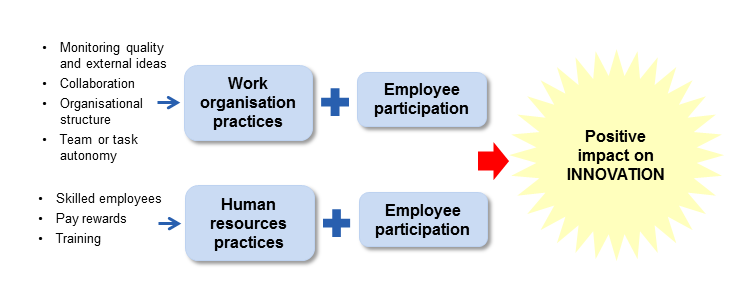
They do! The starting point of the analysis was to group workplace practices into three bundles:
Work organisation: Practices such as monitoring the quality of products or services, monitoring external ideas (the ‘world out there’), the structure of the work organisation, collaboration and the degree of team autonomy or task autonomy.
Human resource management: Recruiting skilled employees, rewarding them with financial incentives additional to their basic pay and providing access to training.
Employee participation: Employee involvement in decision-making and management consultation with employees.
We found that combining work organisation practices with employee participation in decision-making increases the likelihood of innovative change in a company. Similarly, certain human resource practices increased the likelihood of innovation, particularly when combined with employee participation. This means that innovative companies are more likely to implement certain practices in organising work or in human resource management while at the same time ensuring that employees are involved in decision-making.
Bundles of workplace practices boost innovation
How about performance and workplace well-being?
Our analysis also showed that companies that have strong structures supporting the workplace practices described above had higher levels of company performance and workplace well-being compared to those with rudimentary or weak structures. In addition, among companies with these strong structures, innovative companies had significantly higher scores on performance and well-being than non-innovative companies. The highest average levels of performance were found in companies with strong human resource management practices that had introduced innovations in the last three years. Harmonious social dialogue also matters. A trusting relationship between management and employee representatives was associated with higher level of performance and well-being.
Why is this relevant today?
When discussing policies supporting innovation and growth, the focus is often on pursuing the right technical innovations. Work practices and the human factor in innovation tend to be undervalued. In order for technologies to work, however, they need people who are valued for their contribution and who make innovation possible. Investing in improving workplace practices takes time and effort. Each company, its products, services, systems and people are unique, and work practices need to be shaped to the individual company’s circumstances. However, attempting to enhance innovation by adopting a single practice, such as a new bonus system for employees, in the absence of other practices, does not promise the desired dividend. Innovative companies tend to implement bundles of workplace practices, and an essential element in their workplace practices is employee empowerment through participation.
80–100 production ideas per year
Previous Eurofound work explored the paths companies take to workplace innovation, and it revealed that organisational choices do matter. Companies followed different routes to achieve their objectives, but they understood and were motivated by the economic benefits of such initiatives. The impact on the organisation included high performance, sustainability and employee engagement, while the benefits for employees included challenging jobs, learning opportunities and the power of influence. One chemical company we studied produced 80–100 production ideas a year thanks in part to a participative culture where employees were adequately recognised and rewarded.
Managers and professionals tend to have better opportunities than employees in other job categories to participate in work improvements, according to data from another Eurofound survey, the European Working Conditions Survey. But our ECS data show that providing broad opportunities for employees to be involved in such decision-making tends to be linked to innovation.
Recognising the human factor
National and regional agencies that design or implement innovation-support programmes, particularly for SMEs, need to recognise the non-technological side of innovation. SMEs themselves would benefit from an awareness of the contribution certain combinations of workplace practices make, taking into account what our research has found.
Planning for the workplace of the future is a huge challenge for businesses, managers and policymakers. Innovation is a driver of growth, and achieving it demands a more holistic approach. Embracing all aspects of innovation, both technological and non-technological, can produce a synergistic effect. Managers should look for more integrated solutions rather than ad hoc practices. It is time innovation takes the human dimension into account.
Image: ©Shutterstock/Dmitry Kalinovsky
Autori
Stavroula Demetriades
Senior research managerStavroula Demetriades este senior research manager în cadrul unității de ocupare a forței de muncă din cadrul Eurofound. Ea este responsabilă de cercetare în domeniile tranziției verzi și juste, dialogului social, practicilor de management, inovării și muncii hibride. Deține un doctorat în sociologie de la Universitatea din Aalborg, Danemarca. De asemenea, are un masterat în politici economice de la Trinity College Dublin și un masterat în dezvoltare regională de la Universitatea din Atena. Înainte de a se alătura Eurofound în 1999, a lucrat în institute de cercetare, în diferite posturi din sectorul public și privat și a realizat studii organizaționale și socioeconomice. Principalele sale interese de cercetare includ tranziția verde și justă, gestionarea resurselor umane, sistemele de lucru, inovarea, ocuparea forței de muncă și dialogul social. De asemenea, este profesor adjunct la Școala de Afaceri de la University College Dublin.
Franz Ferdinand Eiffe
Research managerFranz Eiffe este director de cercetare în cadrul unității de viață profesională a Eurofound. Este implicat în proiecte privind munca durabilă, analize cantitative și convergență ascendentă în UE, precum și în pregătirea celui de-al patrulea sondaj european al companiilor. Înainte de a se alătura Eurofound în 2016, a fost șef al unității "Analiză" la Statistics Austria din Viena și lider de proiect pentru "Cum este Austria? Măsurarea bogăției și a progresului dincolo de PIB". Deține un doctorat în economie de la Universitatea de Economie din Viena (WU), unde a lucrat și ca cercetător asociat din 2005 până în 2009 și lector până în 2016.
Related content
22 June 2017
Innovation is an important driver of improved competitiveness, productivity and growth potential. This report explores which workplace practices have the strongest links to innovative company behaviour, looking at innovation in the form of new or significantly changed products or processes, new or improved marketing methods, and organisational change. It also explores links between innovation and company performance and workplace well-being, and examines the role of social dialogue in enhancing performance, well-being and innovation. The use of monitoring instruments for internal quality and external developments turned out to be among the strongest determinants of overall innovation; the degree of workers’ autonomy was another important factor. The probability of innovation is boosted when strong work organisation structures are combined with direct employee participation – for instance, involvement in solving problems or improving the quality of production.
9 September 2015
Workplace innovation (WPI) refers to practices that enable employees to participate in organisational change in such a way as to improve the quality of their working life and organisational performance. This report examines the motives behind the adoption of WPI and describes its implementation across companies in Europe. It analyses the impacts of WPI from the perspective of the different players – organisation, management, employees and employee representatives – in 51 companies across 10 EU Member States. The analysis reveals that while there is significant variation in the types of WPI practices in companies, the process of why and how these practices are implemented shows considerable similarity. While the reasons for introducing WPI are mainly related to enhancing efficiency, competitiveness and innovation, one positive result seems to be to strengthen the position of employees and employee representatives. As a result, WPI outcomes often lead to both enhanced economic performance and a better quality of working life for all concerned.


