&w=3840&q=90)
Minimum wage
The term ‘minimum wage’ refers to the regulatory restriction on the lowest rate payable by employers to workers. Statutory minimum wages are regulated by formal laws or statutes. Collectively agreed minimum wages are stipulated within collective agreements between trade unions and employers. The term ‘national minimum wages’ is used when countries have one (or more) basic rates covering workers nationwide. They can be either statutory or collectively agreed.
Find the latest content on this topic below.
Minimum wages on the rise: Effects and policy lessons from a decade of change
This policy brief examines how national minima increases may affect employees’ pay levels, wage inequality, collective bargaining and the wider employment structure.Low-paid jobs: Employment trends and impact of minimum wage policies
This report examines the long-term effects of minimum wage policies on employment structures across the EU-27 over the past two decades. It systematically analyses how changes in sectoral and occupational employment patterns are linked to these policies.Minimum wages in 2026: Annual review
Minimum wage setting across the EU has become an increasingly dynamic and closely watched policy area, shaped by the transposition of the EU Minimum Wage Directive and a decade of sustained real-terms growth in statutory rates. This report examines the wage-setting discussions that took place across Member States and Norway in 2025, focusing on the countries with and without a national minimum wage, the interplay between minimum wages and collective bargaining in low-paid sectors, and the growing role of indicative reference values in shaping national decisions.Last updated: 4 September 2026
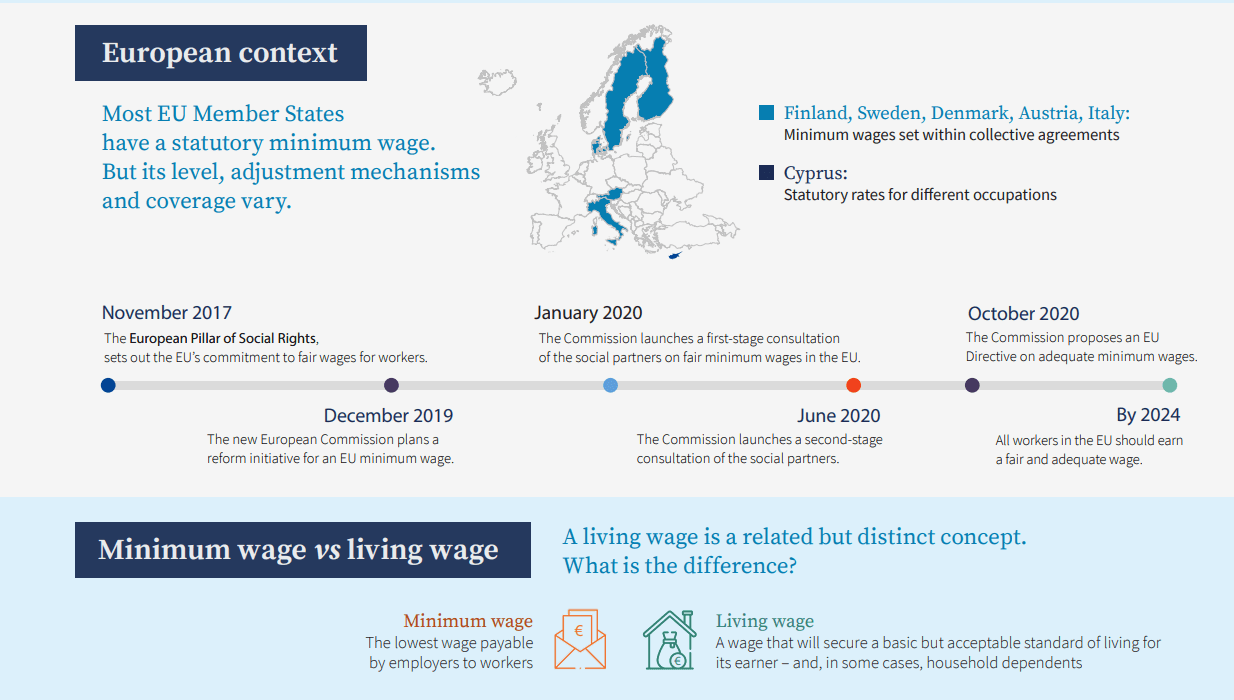
Our infographic provides further details of the situation as of 2020.
Episode 32How are minimum wage levels changing in Europe?
In this episode Mary McCaughey sits down with Eurofound expert Carlos Vacas Soriano to explore how minimum wages have changed in Europe over the past year, as well as the implications of these shifts.Listeners are invited to dive into the intricacies of Europe's minimum wage dynamics and the factors driving these changes. The conversation also sheds light on the broader implications of minimum wage change for income inequalities and gender equality.Eurofound provides regular updates on pay in the EU, including an annual study on how minimum wage rates have developed across the EU (as well as Norway), reviewing how national governments and social partners engage in setting new rates. The Agency also looks at the concept of a living wage, aimed at guaranteeing workers and their families a decent level of living and social participation in response to the inadequacy of income for many working households reliant on existing national minimum wage rates.
Most EU Member States have a national (statutory) minimum wage in place, although its level, adjustment mechanisms and coverage vary. Austria, Denmark, Finland, Italy and Sweden have minimum wages set within collective agreements.
The European Pillar of Social Rights, proclaimed in 2017, sets out the EU’s commitment to fair wages for workers. This includes ensuring adequate wages for workers to allow them and their families to have a decent standard of living, safeguarding the ability of the low-skilled and young workers to find employment, while also making work financially attractive. The Action Plan to implement the Pillar, published in March 2021, has paved the way for a reform initiative for an EU minimum wage.
On 28 October 2020, the Commission put forward a proposal for an EU Directive on adequate minimum wages. This was followed by a political agreement between the European Parliament and the Member States on 7 June 2022. The Minimum Wages Directive was adopted in October 2022. It aims to improve standards of living with a view to achieving upward convergence and reducing in-work poverty, wage inequalities, and the gender pay gap. Member States were required to transpose the directive into national law by November 2024 (Article 17). In 2023, Denmark requested the full or alternatively partial annulment of the directive from the Court of Justice of the EU (C-19/23). On 11 November 2025 the CJEU passed its ruling, confirming the legal validity of it, subject to a partial annulment.
Last updated: 3 June 2026
Eurofound's minimum wage country profiles describe how minimum wages are regulated and set in countries of the European Union and Norway. They can be read as background information for Eurofound’s annual review of minimum wage setting series.
This is a selection of the most important outputs for this topic.
1 September 2026
Minimum wages in 2026: Annual review
&w=3840&q=75)
29 January 2026
National minimum wages, 2026 (chart)

30 January 2026
Real growth in minimum wages in 2026, amid both progress and pullback on Member States’ ambitions

26 January 2024
Minimum wages for low-paid workers in collective agreements
In this pilot project, Eurofound successfully established the feasibility of, and piloted, an EU-wide database of minimum pay rates contained in collective agreements related to low-paid workers. A conceptual and measurement framework was devised, a total of 692 collective agreements – related to 24 low-paid sectors of interest – were selected to be ‘fully coded’ and representative data on negotiated minimum pay were compiled for 24 EU Member States. Based on more than 3,202 renewal texts, time series of collectively agreed minimum rates were created from 2015 to 2022 for 19 countries. This is the first time that an EU-wide data collection has provided comparative time series on negotiated pay. Key findings are is that in some countries outdated agreements contain rates below the applicable statutory minima, and that the potential of collective agreements to regulate pay generally or for employees earning higher wages than the minimum pay is not always fully capitalised on.
See also the national country reports (Eurofound papers), providing meta-data for the data collection, at the end of this web page.

27 November 2023
Minimum wages: Non-compliance and enforcement across EU Member States – Comparative report
In the EU, non-compliance with statutory or negotiated minimum wages averages 6.93% or 1.3%, depending on the statistics used. The lowest national estimate is 0.01% in Belgium and the highest is 11.59% in Hungary. It mostly affects young workers, those on fixed-term or part-time contracts and those working for small companies. It is more common in services than in manufacturing, and is characterised by shorter working time. Member States monitor, enforce and promote compliance in similar ways, although with some differences. This report identifies hindering and enabling factors. Some countries focus on specific economic sectors, such as construction, domestic work, platform work, agriculture and meat processing. National authorities often enforce minimum wages indirectly by helping employers comply, raising workers’ awareness, and helping stakeholders increase cooperation and develop faster procedures. Combining these soft initiatives with tougher measures increases the effectiveness of inspectorates’ actions in enforcing compliance with minimum wages.
30 November 2022
Regulating minimum wage and other forms of pay for the self-employed
This report is carried out in the context of the three-year pilot project (2021–2023), ‘Role of the minimum wage in establishing the Universal Labour Guarantee’, mandated to Eurofound by the European Commission. Its focus is module 3 of the project, investigating minimum wages and other forms of pay for the self-employed. Out of concern for the challenging conditions faced by certain groups of self-employed workers, some Member States have established or are in discussions about proposing some statutory forms of minimum pay for selected categories of the self-employed. The main objective of the report is to understand how minimum wages, wage rates, tariffs, fees and other forms of pay could be fixed for specific jobs or professions in sectors having a high level of ‘vulnerable’ workers, as well as ‘concealed’ self-employed. While the majority of Member States allow trade union representation, the right to collective bargaining for the self-employed is much more limited. Only a small number of Member States provide examples of collectively agreed minimum wages or other forms of pay for the self-employed.
15 June 2022
How to ensure adequate minimum wages in an age of inflation

Minimum wages in the EU

Researchers at Eurofound provide expert insights and can be contacted for questions or media requests.
Felix Appler
Research support officerFelix Appler is a research support officer in the Working Life unit at Eurofound. His work focuses on industrial relations, minimum wages and building databases associated with these topics. Previously, he worked at the Federal Statistical Office of Germany (Destatis) and the World Bank in East Africa carrying out household surveys and research on labour markets and poverty. Felix holds a Master’s degree in Economics from the University of Bonn.
Carlos Vacas Soriano
Senior research managerCarlos Vacas Soriano is a senior research manager in the Employment unit at Eurofound. He works on topics related to wage and income inequalities, minimum wages, low pay, job quality, temporary employment and segmentation, and job quality. Prior to joining Eurofound in 2010, he worked as a macroeconomic analyst for the European Commission and as a researcher in European labour markets at the Spanish Central Bank. He holds an MA in European Economic Studies from the College of Europe in Bruges and a PhD in Labour Economics from the University of Salamanca (Doctor Europaeus).
Christine Aumayr-Pintar
Senior research managerChristine Aumayr-Pintar is a senior research manager in the Working Life unit at Eurofound. Her primary research expertise – approached from a comparative EU-wide standpoint – centres on minimum wages, collectively negotiated pay, social dialogue and gender pay transparency. She has co-authored Eurofound's annual reviews on minimum wages for the past decade, has a passion for industrial relations data and has developed – among other projects – the database on minimum wages in collective agreements for low-paid workers and the EU PolicyWatch database. Between 2021 and 2026 she also coordinated Eurofound's research on social dialogue and managed the Network of Eurofound Correspondents. Prior to joining Eurofound in 2009 she was a labour markets and regional economics researcher at Joanneum Research in Austria. She holds a Master's degree in Economics and a PhD in Social Science/Economics, having studied economics in Graz, Vienna and Jönköping.
This section provides access to all content that has been published on the topic.