&w=3840&q=90)
Qualité de l’emploi
La qualité de l’emploi complète les mesures de la quantité d’emplois pour fournir une évaluation de la stratégie pour l’emploi. La qualité de l’emploi est un concept multidimensionnel où différents programmes politiques et disciplines mettent l’accent sur différentes dimensions. Dans la plupart des recherches d’Eurofound, la qualité de l’emploi est mesurée au niveau de l’emploi. Il comprend les caractéristiques de l’emploi saisies d’un point de vue objectif, qui peuvent être observées et qui sont liées à la satisfaction des besoins des personnes au travail. Il est composé de toutes les caractéristiques du travail et de l’emploi dont il a été prouvé qu’elles ont un lien de causalité avec la santé et le bien-être. Les aspects positifs et négatifs des emplois sont inclus. Ces indicateurs reflètent les ressources de l’emploi (aspects physiques, psychologiques, sociaux ou organisationnels) et les exigences du travail, ou les processus qui les influencent.
Trouvez le contenu le plus récent sur ce thème ci-dessous.
Briser le cycle : améliorer la qualité de l’emploi peut-il résoudre les pénuries de main-d’œuvre dans l’UE ?
Dans toute l’UE, les pénuries de main-d’œuvre touchent presque toutes les professions identifiées, en particulier celles confrontées à des environnements de travail difficiles et à une mauvaise qualité du temps de travail. En identifiant les écarts de qualité de l’emploi liés à la santé et au bien-être, les décideurs politiques et les employeurs peuvent rendre ces emplois plus attractifs et briser le cycle de pénurie.Le secteur informatique au cœur de l’attention : évolution de la main-d’œuvre numérique de l’UE
Le secteur des TIC stimule la numérisation et l’adoption de l’IA à travers l’Europe, mais des pénuries de main-d’œuvre qualifiée freinent sa croissance. Ce rapport examine l’emploi et les conditions de travail des spécialistes des TIC ainsi que les défis qui façonnent l’un des secteurs les plus cruciaux de l’UE.Gestion algorithmique dans les lieux de travail européens : implications pour l’organisation et les conditions de travail
Cette étude présente une analyse secondaire des données de la septième enquête européenne sur les conditions de travail d’Eurofound (EWCS 2024) qui explore la prévalence des technologies numériques dans les lieux de travail modernes et la diffusion des pratiques de gestion algorithmique. En reliant l’exposition rapportée des travailleurs à des programmes informatiques qui surveillent la performance, répartissent les tâches et planifient le travail avec des indicateurs de qualité du poste, l’analyse évalue comment la technologie remodele le travail. Il identifie également des profils distincts des travailleurs en fonction des modes d’utilisation de la technologie numérique et des caractéristiques associées à chaque profil. Les résultats éclaireront l’élaboration des politiques visant à promouvoir des emplois de haute qualité dans des milieux de travail de plus en plus numériques.Eurofound vise à consolider la position de son enquête européenne sur les conditions de travail (EWCS) en tant qu’outil important d’évaluation comparative de la qualité de l’emploi dans l’Union européenne et au-delà, en alimentant l’élaboration des politiques dans le domaine de la qualité du travail. Les données ont été utilisées pour mener d’autres recherches sur divers sujets liés à la qualité de l’emploi, notamment la qualité de l’emploi dans différentes situations de travail, la qualité de l’emploi de différents groupes sur le marché du travail, l’impact de la qualité de l’emploi sur la qualité de la vie professionnelle et une analyse approfondie des différentes dimensions de la qualité de l’emploi. Les enquêtes européennes auprès des entreprises (ECS) examinent également différentes dimensions de la qualité de l’emploi pour les travailleurs et les employeurs. Des recherches récentes ont également examiné la qualité des emplois dans une perspective mondiale.
La qualité de l’emploi et son amélioration sont une préoccupation politique importante, car des emplois de qualité sont essentiels pour une plus grande participation au marché du travail, un meilleur bien-être et une meilleure performance économique. La qualité de l’emploi est également un élément clé pour rendre le travail durable et permettre aux travailleurs de rester motivés pour rester au travail plus longtemps. Elle est au cœur de l’Agenda pour le travail décent de l’OIT, de la stratégie de l’OCDE pour l’emploi et des politiques de l’Union européenne en matière de qualité du travail afin de créer des emplois plus nombreux et de meilleure qualité. Pour les travailleurs, pour les entreprises et les organisations qui les emploient et pour les sociétés, il y a des avantages associés à des emplois de haute qualité et des coûts associés à des emplois de mauvaise qualité.
En 2025, la Commission européenne prévoit de présenter une feuille de route pour des emplois de qualité en collaboration avec les partenaires sociaux, visant à « soutenir des salaires équitables, de bonnes conditions de travail, la formation et des transitions professionnelles équitables pour les travailleurs et les travailleurs indépendants. Cette initiative s’inscrit dans le cadre des efforts visant à renforcer la compétitivité de l’UE, comme indiqué dans la boussole de compétitivité, et à créer des emplois de qualité.
Priorité de la Commission : soutenir les citoyens, renforcer nos sociétés et notre modèle socialopens in new tab
Organisation internationale du Travail (OIT) : Travail décentopens in new tab
Organisation de coopération et de développement économiques (OCDE) : Stratégie de l’OCDE pour l’emploiopens in new tab
Commission européenne : Stratégie européenne pour l’emploiopens in new tab
Voici une sélection des publications les plus importantes pour ce thème.
3 September 2025
Tendances en matière de qualité de l’emploi : premiers résultats de l’EWCS 2024

30 June 2024
Job quality side of climate change
Workers will experience the effects of climate change in many ways: job insecurity, changes to their work tasks and responsibilities, and changes in their workplaces that may involve different work practices and the development of new activities and products. Climate change risks are associated with increased exposure to hazards, leading to lower standards of job quality, productivity loss and greater job and work insecurity. Nearly half of workers in the EU will experience profound changes in their job tasks as economies adapt to climate change and climate mitigation strategies are implemented. In addition, work is likely to change as a result of company responses to climate change. These changes in work, while increasing the vulnerability of some workers, offer opportunities to improve some dimensions of job quality. This report outlines the complex relationship between job quality and climate change, including the implication of green tasks in selected sectors.

30 January 2024
Self-employment in the EU: Job quality and developments in social protection
Ensuring greater social protection for self-employed people has been the subject of much policy debate in recent years. In 2019, the Council of the European Union adopted a recommendation on access to social protection for workers and the self-employed. Sudden reductions in income during the COVID-19 pandemic highlighted the vulnerability of many self-employed workers. Using data from the European Working Conditions Telephone Survey, this report examines the working conditions of different groups of self-employed people. It analyses measures taken at EU Member State level to better protect self-employed individuals against the risks of unemployment, workplace accidents and sickness, and presents lessons learned from measures implemented during the pandemic.

9 October 2023
Job quality of COVID-19 pandemic essential workers
During the COVID-19 pandemic, a diverse collection of workers ensured the functioning of our societies. In a time of crisis, they maintained access to healthcare, long-term care and other essential goods and services, including food, water, electricity, the internet and waste treatment. These were the COVID-19 pandemic essential, or critical, workers, many of whom risked their physical and mental health by continuing to go to work during the pandemic.
This policy brief investigates the job quality of these critical workers, making use of unique sources of information, including data from the European Working Conditions Telephone Survey 2021, data gathered by correspondents from across the Member States and interviews with EU-level social partner representatives from selected sectors. It examines the experiences of work among critical workers during the pandemic, and highlights imminent challenges to the sustainability of their work. The aim is to discover whether these workers are equipped to support society through future shocks and crises.

26 February 2021
Working conditions and sustainable work: An analysis using the job quality framework
This flagship report summarises the key findings of Eurofound’s research on working conditions conducted over the programming period 2017–2020. It maps the progress achieved since 2000 in improving working conditions and examines whether all workers have benefited equally from positive change. It highlights which groups are the most at risk of experiencing poor working conditions and being left behind. Given the changes in the world of work, emerging challenges for good job quality are identified. The report also provides evidence for measures that could lead to the further improvement of work and the achievement of fair working conditions for all in the EU. The analysis shows that, overall, job quality in the EU is improving, if slowly. Not all workers are benefiting to the same extent, however. Furthermore, gender, age and contractual status have a significant bearing on a person’s working conditions. And while digitalisation helps to address some job quality issues, it also creates new challenges. The COVID-19 pandemic has exacerbated trends, reinforcing concerns and highlighting the importance of achieving job quality for all.

2 March 2020
Gender equality at work
Gender inequality at work persists across Europe, despite the long standing attention paid and efforts made to tackle it. This Eurofound report presents a closer look at women’s and men’s working conditions, using data from Eurofound’s European Working Conditions Survey (EWCS) and complementing previous Eurofound research on, among other things, working time patterns, work–life balance and workers’ health. Beyond the general differences in the labour market, it highlights many important gaps in men’s and women’s working conditions and job quality which require specific attention. According to the EWCS data, the reduction of gender gaps in those areas showing improvement over the last 5 to 10 years remains limited. European and national strategies aimed at achieving job quality for all, that seek to mainstream gender equality, could help address persistent inequalities between men and women.

12 October 2020
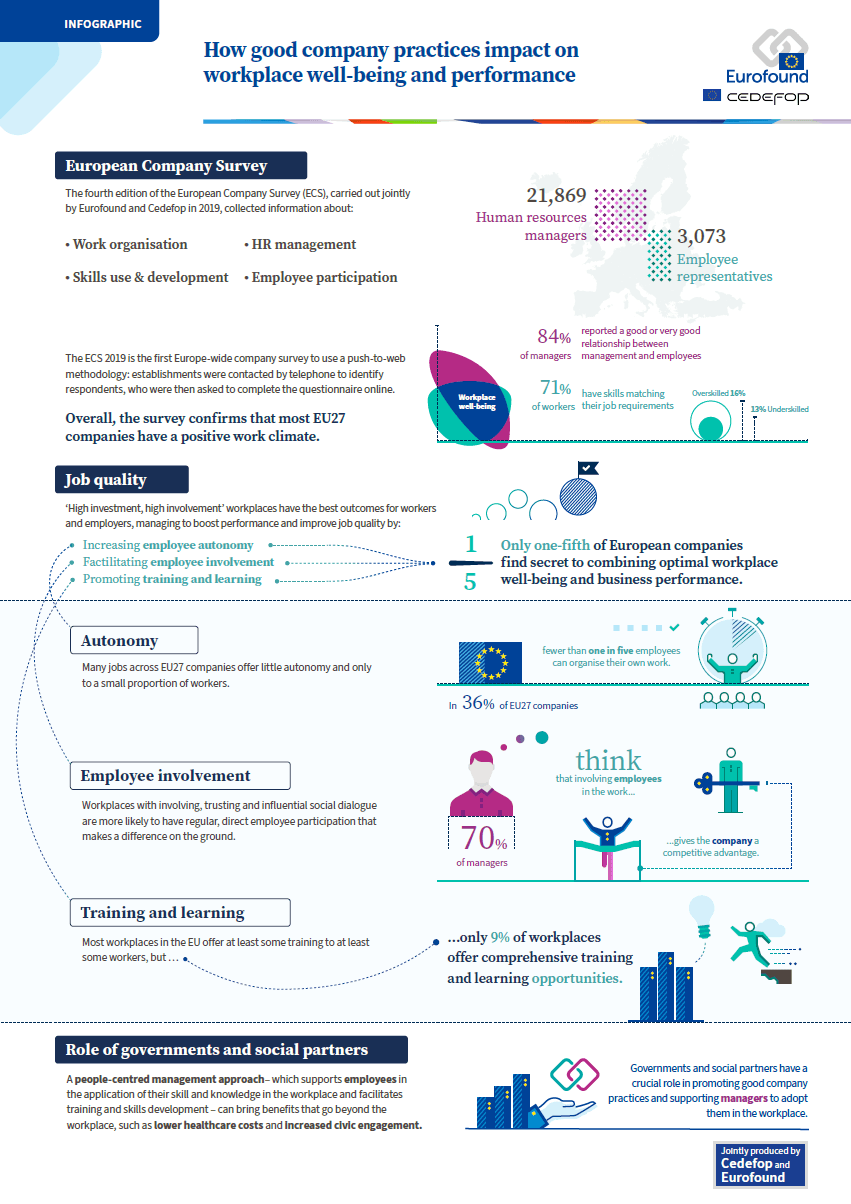
European Company Survey 2019 - Workplace practices unlocking employee potential
This report is based on the fourth edition of the European Company Survey (ECS), which was carried out jointly by Eurofound and Cedefop in 2019. It describes a wide range of practices and strategies implemented by European companies in terms of work organisation, human resource management, skills use and skills development, and employee voice. The report shows how these practices are combined and how the resulting ‘bundles of practices’ are associated with two outcomes beneficial to employees and employers: workplace well-being and establishment performance.
The analysis finds that the establishments that are most likely to generate this win–win outcome are those that combine a high degree of worker autonomy, a balanced motivational strategy, a comprehensive training and learning strategy, and high levels of direct employee involvement in decision-making, as well as offering managerial support for these practices. To boost the adoption of employee-oriented practices – particularly in relation to autonomy, skills and employee involvement – managers should be offered appropriate support, as they play a key role in the decision to initiate workplace change. They are also crucial to its success, as they must continuously support the workplace practices implemented.

6 May 2019
Working conditions in a global perspective
Job quality is a major focus of policymakers around the world. For workers, the enterprises that employ them and for societies, there are benefits associated with high-quality jobs, and costs associated with poor-quality jobs. This report – the result of a pioneering project by the International Labour Organization and Eurofound – provides a comparative analysis of job quality covering approximately 1.2 billion workers in Europe, Asia and the Americas. It analyses seven dimensions of job quality: the physical environment, work intensity, working time quality, the social environment, skills and development, prospects, and earnings, finding both important differences and similarities between countries. By analysing positive and negative aspects of job quality in different countries and societies, the report provides a way to look beyond national explanations, to see how some groups of workers are affected more than others and understand the particular issues for women workers around the world – in support of evidence-based policymaking to improve job quality.

17 November 2016
Sixth European Working Conditions Survey – Overview report

Les chercheurs d'Eurofound fournissent des informations spécialisées et peuvent être contactés pour des questions ou des demandes des médias.
Jorge Cabrita
Senior research managerJorge Cabrita est responsable principal de recherche au sein de l’unité Working Life, où il conçoit, coordonne et gère la recherche européenne et diffuse ses résultats. Ses principaux domaines d’expertise incluent les conditions de travail et la qualité de l’emploi, le temps de travail et l’équilibre vie professionnelle–vie privée, la santé et le bien-être des travailleurs, l’égalité des sexes, ainsi que les impacts socioéconomiques de la transition verte. Il dirige actuellement la recherche sur l’évolution du temps de travail et la qualité de l’emploi dans les régions vulnérables au climat, et co-dirige la mise en œuvre de l’Enquête européenne sur les conditions de travail 2030. Auparavant, il a été chercheur au Centre d’Études pour l’Intervention Sociale et au Centre de Recherche sur l’Économie Portugaise, et a travaillé comme formateur et consultant. Il est titulaire d’une licence en économie et d’un master en systèmes socio-organisationnels d’activité économique de la Lisbonne School of Economics.
Agnès Parent-Thirion
Senior research managerAgnès Parent-Thirion est responsable senior de recherche dans l’unité Working Life chez Eurofound, supervisant la planification et le développement de la recherche sur les conditions de travail. Elle joue un rôle clé dans l’Enquête européenne sur les conditions de travail (EWCS), co-dirigeant la préparation et le développement du questionnaire pour EWCS 2030. Ses intérêts de recherche incluent la qualité de l’emploi, l’organisation du travail, le genre, les risques psychosociaux et l’impact des transitions vertes et numériques sur la vie professionnelle. Forte de plus de vingt ans d’expérience sur des enquêtes comparatives européennes, Agnès est spécialisée dans le développement de questionnaires, le codage des professions, le contrôle qualité et l’analyse. Elle est diplômée en économie et management des universités Paris IX Dauphine et Paris I Panthéon Sorbonne et détient un diplôme de troisième cycle en statistiques du Trinity College Dublin. Elle a également suivi une formation spécialisée en leadership IA (MIT Sloan Executive Education) et les principaux défis de la transition (Campus de la Transition). Avant de rejoindre Eurofound, elle a travaillé plusieurs années à la Commission européenne.
Cette section donne accès à tout le contenu qui a été publié sur le thème.