&w=3840&q=90)
Kvaliteta posla
Kvaliteta radnih mjesta nadopunjuje mjere kvantiteta radnih mjesta kako bi se osigurala procjena strategije zapošljavanja. Kvaliteta radnih mjesta višedimenzionalni je koncept u kojem različiti politički programi i discipline naglašavaju različite dimenzije. U većini Eurofoundovih istraživanja kvaliteta radnih mjesta mjeri se na razini radnog mjesta. Uključuje značajke posla snimljene iz objektivne perspektive, koje se mogu promatrati i povezane su s zadovoljavanjem potreba ljudi s posla. Sastoji se od svih karakteristika rada i zapošljavanja za koje je dokazano da imaju uzročno-posljedičnu vezu sa zdravljem i dobrobiti. Uključene su pozitivne i negativne značajke poslova. Ti pokazatelji odražavaju radne resurse (fizičke, psihološke, socijalne ili organizacijske aspekte) i zahtjeve posla ili procese koji na njih utječu.
Najnoviji sadržaj o ovoj temi pronađite u nastavku.
Prekidanje tog kruga: Može li poboljšanje kvalitete radnih mjesta riješiti nedostatak radne snage u EU-u?
Diljem EU-a, nedostatak radne snage pogađa gotovo sva identificirana zanimanja, osobito ona koja se suočavaju s izazovnim radnim okruženjem i lošom kvalitetom radnog vremena. Uočavanjem razlika u kvaliteti rada povezanih sa zdravljem i dobrobiti, donositelji politika i poslodavci mogu učiniti ta radna mjesta privlačnijima i prekinuti ciklus nestašice.IT sektor u fokusu: Evolucija digitalne radne snage EU-a
ICT sektor potiče digitalizaciju i usvajanje umjetne inteligencije diljem Europe, no nedostatak kvalificirane radne snage usporava njegov rast. Ovo izvješće analizira uvjete zapošljavanja i rada ICT stručnjaka te izazove koji oblikuju jedan od najvažnijih sektora EU-a.Algoritamsko upravljanje na europskim radnim mjestima: implikacije za organizaciju rada i radne uvjete
Ova studija predstavlja sekundarnu analizu podataka iz Eurofoundove Sedme europske ankete o radnim uvjetima (EWCS 2024) koja istražuje raširenost digitalnih tehnologija u modernim radnim mjestima i širenje algoritamskih menadžerskih praksi. Povezujući prijavljenu izloženost radnika računalnim programima koji prate izvedbu, raspoređuju zadatke i rasporede rada s pokazateljima kvalitete posla, analiza procjenjuje kako tehnologija preoblikuje rad. Također identificira različite profile radnika na temelju obrazaca korištenja digitalne tehnologije i karakteristika povezanih s tim profilom. Nalazi će informirati donošenje politika usmjerenih na promicanje visokokvalitetnih radnih mjesta u sve digitalnijim radnim mjestima.Eurofound nastoji učvrstiti stajalište svojeg Europskog istraživanja o radnim uvjetima (EWCS) kao važnog alata za uspoređivanje kvalitete radnih mjesta u Europskoj uniji i izvan nje, što doprinosi razvoju politika u području kvalitete rada. Podaci su korišteni za provođenje daljnjih istraživanja o različitim temama vezanim uz kvalitetu radnih mjesta, uključujući kvalitetu radnih mjesta u različitim radnim situacijama, kvalitetu radnih mjesta različitih skupina na tržištu rada, utjecaj kvalitete radnih mjesta na kvalitetu radnog vijeka i dubinsku analizu pojedinih dimenzija kvalitete radnih mjesta. Europske ankete poduzećima (ECS) također razmatraju različite dimenzije kvalitete radnih mjesta za radnike i poslodavce. Nedavna istraživanja također su proučavala kvalitetu radnih mjesta u globalnoj perspektivi.
Kvaliteta radnih mjesta i njihovo poboljšanje važan je problem politike jer su kvalitetna radna mjesta ključna za veću participaciju radne snage, veću dobrobit i povećane gospodarske rezultate. Kvaliteta radnih mjesta također je ključna sastavnica za održivost rada i omogućavanje radnicima da ostanu motivirani da dulje ostanu na radnom mjestu. To je ključno za Program za dostojanstven rad ILO-a, strategiju OECD-a za zapošljavanje i politike Europske unije za kvalitetu rada kako bi se stvorilo više i boljih radnih mjesta. Za radnike, poduzeća i organizacije koje ih zapošljavaju te za društva postoje koristi povezane s visokokvalitetnim radnim mjestima i troškovi povezani s nekvalitetnim radnim mjestima.
Europska komisija planira 2025. u suradnji sa socijalnim partnerima predstaviti plan za kvalitetna radna mjesta s ciljem "podupiranja pravednih plaća, dobrih radnih uvjeta, osposobljavanja i pravednog prelaska s radnog mjesta za radnike i samozaposlene osobe. Ovom se inicijativom podupire nastojanje da se ojača konkurentnost EU-a kako je navedeno u Kompasu konkurentnosti i otvore kvalitetna radna mjesta.
Prioritet Komisije: Potpora ljudima, jačanje naših društava i našeg socijalnog modelaopens in new tab
Međunarodna organizacija rada (ILO): Dostojanstven radopens in new tab
Organizacija za ekonomsku suradnju i razvoj (OECD): Strategija OECD-a za zapošljavanjeopens in new tab
Europska komisija: Europska strategija zapošljavanjaopens in new tab
Ovo je izbor najvažnijih rezultata za ovu temu.
3 September 2025
Trendovi u kvaliteti radnih mjesta: prvi nalazi EWCS-a 2024.

30 June 2024
Job quality side of climate change
Workers will experience the effects of climate change in many ways: job insecurity, changes to their work tasks and responsibilities, and changes in their workplaces that may involve different work practices and the development of new activities and products. Climate change risks are associated with increased exposure to hazards, leading to lower standards of job quality, productivity loss and greater job and work insecurity. Nearly half of workers in the EU will experience profound changes in their job tasks as economies adapt to climate change and climate mitigation strategies are implemented. In addition, work is likely to change as a result of company responses to climate change. These changes in work, while increasing the vulnerability of some workers, offer opportunities to improve some dimensions of job quality. This report outlines the complex relationship between job quality and climate change, including the implication of green tasks in selected sectors.

30 January 2024
Self-employment in the EU: Job quality and developments in social protection
Ensuring greater social protection for self-employed people has been the subject of much policy debate in recent years. In 2019, the Council of the European Union adopted a recommendation on access to social protection for workers and the self-employed. Sudden reductions in income during the COVID-19 pandemic highlighted the vulnerability of many self-employed workers. Using data from the European Working Conditions Telephone Survey, this report examines the working conditions of different groups of self-employed people. It analyses measures taken at EU Member State level to better protect self-employed individuals against the risks of unemployment, workplace accidents and sickness, and presents lessons learned from measures implemented during the pandemic.

9 October 2023
Job quality of COVID-19 pandemic essential workers
During the COVID-19 pandemic, a diverse collection of workers ensured the functioning of our societies. In a time of crisis, they maintained access to healthcare, long-term care and other essential goods and services, including food, water, electricity, the internet and waste treatment. These were the COVID-19 pandemic essential, or critical, workers, many of whom risked their physical and mental health by continuing to go to work during the pandemic.
This policy brief investigates the job quality of these critical workers, making use of unique sources of information, including data from the European Working Conditions Telephone Survey 2021, data gathered by correspondents from across the Member States and interviews with EU-level social partner representatives from selected sectors. It examines the experiences of work among critical workers during the pandemic, and highlights imminent challenges to the sustainability of their work. The aim is to discover whether these workers are equipped to support society through future shocks and crises.

26 February 2021
Working conditions and sustainable work: An analysis using the job quality framework
This flagship report summarises the key findings of Eurofound’s research on working conditions conducted over the programming period 2017–2020. It maps the progress achieved since 2000 in improving working conditions and examines whether all workers have benefited equally from positive change. It highlights which groups are the most at risk of experiencing poor working conditions and being left behind. Given the changes in the world of work, emerging challenges for good job quality are identified. The report also provides evidence for measures that could lead to the further improvement of work and the achievement of fair working conditions for all in the EU. The analysis shows that, overall, job quality in the EU is improving, if slowly. Not all workers are benefiting to the same extent, however. Furthermore, gender, age and contractual status have a significant bearing on a person’s working conditions. And while digitalisation helps to address some job quality issues, it also creates new challenges. The COVID-19 pandemic has exacerbated trends, reinforcing concerns and highlighting the importance of achieving job quality for all.

2 March 2020
Gender equality at work
Gender inequality at work persists across Europe, despite the long standing attention paid and efforts made to tackle it. This Eurofound report presents a closer look at women’s and men’s working conditions, using data from Eurofound’s European Working Conditions Survey (EWCS) and complementing previous Eurofound research on, among other things, working time patterns, work–life balance and workers’ health. Beyond the general differences in the labour market, it highlights many important gaps in men’s and women’s working conditions and job quality which require specific attention. According to the EWCS data, the reduction of gender gaps in those areas showing improvement over the last 5 to 10 years remains limited. European and national strategies aimed at achieving job quality for all, that seek to mainstream gender equality, could help address persistent inequalities between men and women.

12 October 2020
European Company Survey 2019 - Workplace practices unlocking employee potential
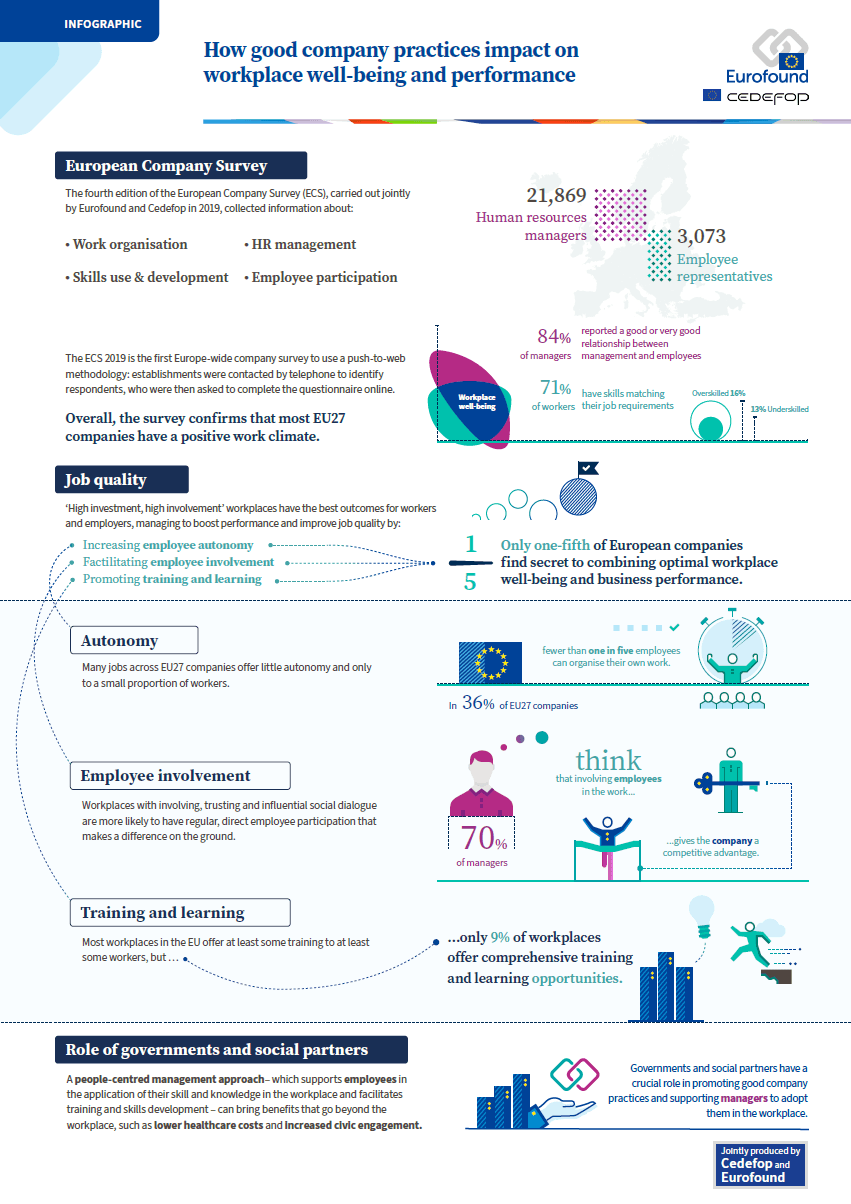
This report is based on the fourth edition of the European Company Survey (ECS), which was carried out jointly by Eurofound and Cedefop in 2019. It describes a wide range of practices and strategies implemented by European companies in terms of work organisation, human resource management, skills use and skills development, and employee voice. The report shows how these practices are combined and how the resulting ‘bundles of practices’ are associated with two outcomes beneficial to employees and employers: workplace well-being and establishment performance.
The analysis finds that the establishments that are most likely to generate this win–win outcome are those that combine a high degree of worker autonomy, a balanced motivational strategy, a comprehensive training and learning strategy, and high levels of direct employee involvement in decision-making, as well as offering managerial support for these practices. To boost the adoption of employee-oriented practices – particularly in relation to autonomy, skills and employee involvement – managers should be offered appropriate support, as they play a key role in the decision to initiate workplace change. They are also crucial to its success, as they must continuously support the workplace practices implemented.

6 May 2019
Working conditions in a global perspective
Job quality is a major focus of policymakers around the world. For workers, the enterprises that employ them and for societies, there are benefits associated with high-quality jobs, and costs associated with poor-quality jobs. This report – the result of a pioneering project by the International Labour Organization and Eurofound – provides a comparative analysis of job quality covering approximately 1.2 billion workers in Europe, Asia and the Americas. It analyses seven dimensions of job quality: the physical environment, work intensity, working time quality, the social environment, skills and development, prospects, and earnings, finding both important differences and similarities between countries. By analysing positive and negative aspects of job quality in different countries and societies, the report provides a way to look beyond national explanations, to see how some groups of workers are affected more than others and understand the particular issues for women workers around the world – in support of evidence-based policymaking to improve job quality.

17 November 2016
Sixth European Working Conditions Survey – Overview report

Istraživači Eurofounda pružaju stručne uvide i mogu ih se kontaktirati za pitanja ili upite medija.
Jorge Cabrita
Senior research managerJorge Cabrita je viši voditelj istraživanja u jedinici za radni život, gdje dizajnira, koordinira i upravlja istraživanjima diljem Europe te širi njihove nalaze. Njegova glavna područja stručnosti uključuju radne uvjete i kvalitetu rada, radno vrijeme i ravnotežu između posla i privatnog života, zdravlje i dobrobit radnika, rodnu ravnopravnost te socioekonomske utjecaje zelene tranzicije. Trenutno vodi istraživanja o razvoju radnog vremena i kvaliteti radnih mjesta u klimatski osjetljivim regijama te suvoditelj provedbe Europske ankete o radnim uvjetima 2030. Prije toga bio je istraživač u Centru za studije socijalne intervencije i Istraživačkom centru za portugalsku ekonomiju, te je radio kao trener i konzultant. Diplomirao je ekonomiju i magistrirao socio-organizacijske sustave ekonomske aktivnosti na Lisabonskoj školi ekonomije.
Agnès Parent-Thirion
Senior research managerAgnès Parent-Thirion je viša voditeljica istraživanja u jedinici za radni život pri Eurofoundu, gdje nadzire planiranje i razvoj istraživanja radnih uvjeta. Ima ključnu ulogu u Europskoj anketi o radnim uvjetima (EWCS), gdje suvodi pripremu i razvoj upitnika za EWCS 2030. Njezini istraživački interesi uključuju kvalitetu posla, organizaciju rada, rod, psihosocijalne rizike te utjecaj zelenih i digitalnih tranzicija na radni život. S više od dva desetljeća iskustva u radu na europskim komparativnim anketama, Agnès se specijalizirala za izradu upitnika, kodiranje zanimanja, kontrolu kvalitete i analizu. Diplomirala je ekonomiju i menadžment na sveučilištima Paris IX Dauphine i Paris I Panthéon Sorbonne te ima poslijediplomski diplomu iz statistike sa Trinity College Dublin. Također je završila specijaliziranu obuku o AI vodstvu (MIT Sloan Executive Education) i glavnim izazovima tranzicije (Campus de la Transition). Prije nego što se pridružila Eurofoundu, radila je nekoliko godina u Europskoj komisiji.
Ovaj odjeljak pruža pristup cjelokupnom sadržaju koji je objavljen o temi.