Collectieve onderhandelingen als mechanisme om loongelijkheid tussen mannen en vrouwen te bevorderen
Gegevens: één figuur and één tabel
De sociale partners kunnen bedrijven helpen het gelijke loonprincipe toe te passen door ervoor te zorgen dat de loonschalen in sectorale collectieve overeenkomsten gebaseerd zijn op objectieve en genderneutrale criteria.
Loonverschillen tussen mannen en vrouwen – dat wil zeggen, wanneer vrouwen minder verdienen dan mannen voor hetzelfde werk of werk van gelijke waarde, of wanneer de opzet van loonstructuren en loopbaanontwikkeling het ene geslacht ten opzichte van het andere benadeelt – kunnen om verschillende redenen ontstaan, waaronder directe en indirecte discriminatie. Ze kunnen ook voortkomen uit een onderschatting van werk dat traditioneel door vrouwen werd uitgevoerd. De Richtlijn Loontransparantie pakt dit deels aan door bedrijven te verplichten ervoor te zorgen dat hun loonstructuren gebaseerd zijn op objectieve, genderneutrale functiebeoordeling die de uitvoering van het principe van gelijke waarde ondersteunt. Het moedigt ook sociale partners aan om gelijke beloning voor dezelfde of gelijkwaardige banen mee te nemen in collectieve onderhandelingen. Dit artikel reflecteert op dit principe en hoe sociale partners de implementatie ervan kunnen ondersteunen.
De richtlijn bevestigt dat collectieve arbeidsovereenkomsten een belangrijke rol kunnen spelen bij het bevorderen van de toepassing van het principe van gelijke beloning, maar dat hun invloed van verschillende factoren afhangt. Het recente onderzoeksrapport van Eurofound beschrijft twee 'kanalen' waardoor overeenkomsten gelijke beloning kunnen bevorderen.
Hogere collectieve overeenkomsten kunnen genderneutrale functieclassificaties en loonstructuren bieden om de loonvaststelling van bedrijven te sturen ('verticale invloed').4
Sociale partners kunnen proberen de loonvaststelling en waardering van banen tussen collectieve overeenkomsten te coördineren of de concentratie van een bepaald geslacht in bepaalde functies aan te pakken met het oog op het verminderen van loonverschillen tussen sectoren en banen ('horizontale benadering').
Beide kanalen zijn levensvatbaar, maar de impact van de richtlijn op de implementatie van het recht op gelijke beloning zal waarschijnlijk sterker zijn langs het verticale kanaal.
The role and influence of collective agreements in advancing pay equity for jobs of equal value
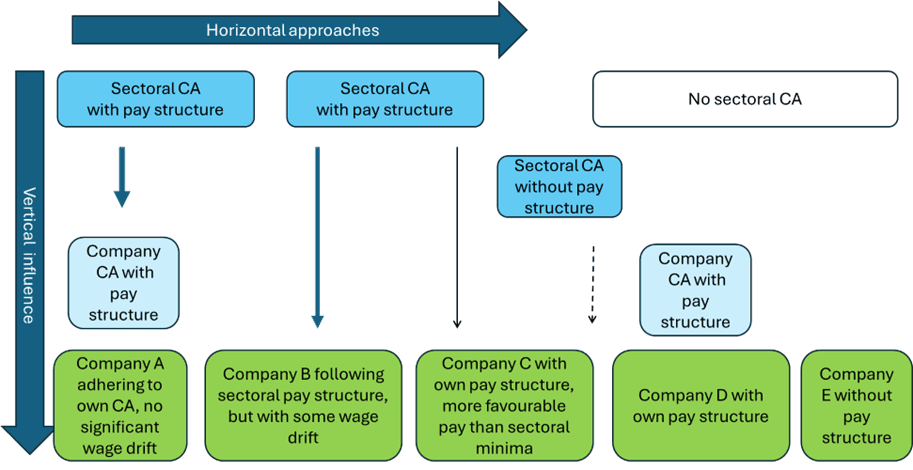
Note: CA, collective agreement. The size of the arrows reflects the degree of influence sectoral collective agreements may have on company-level pay equity outcomes.
Bron: Authors
Vertical invloed: Van de sectorale overeenkomst tot het bedrijf
De mate waarin collectieve overeenkomsten de uitvoering van het gelijke loonprincipe verticaal kunnen ondersteunen, wordt bepaald door verschillende factoren.
De meest voor de hand liggende is of er een hogere collectieve overeenkomst van kracht is. Het is algemeen bekend dat de onderhandelingsdekking in de EU ongelijk is – per land en sector. Maar zelfs waar (hogere) onderhandelingsovereenkomsten bestaan, is er geen garantie dat ze loonstructuren bevatten (of het loon überhaupt reguleren). Waar er geen collectieve arbeidsovereenkomsten zijn die genderneutrale loonstructuren vastleggen, is het aan individuele bedrijven om hun eigen loonstructuren te ontwikkelen en te herzien. In zulke gevallen kan onderhandelingen op bedrijfsniveau nog steeds garanderen dat de uitkomst onderhandeld en, naar verluidt, meer legitiem is.
Maar zelfs waar collectieve arbeidsovereenkomsten loonstructuren bevatten, kunnen bedrijven besluiten daarvan af te wijken en verschillende (meestal hogere) 5 lonen aan sommige of alle werknemers te betalen, zolang het minimumloon voor elke categorie wordt nageleefd. Dit wordt 'loondrift' genoemd. Waar loonsdrift bestaat en de werkelijke lonen verschillen van de collectief overeengekomen minimum, zijn collectieve overeenkomsten opnieuw beperkter in hun vermogen om de naleving van het principe van gelijke beloning te beïnvloeden. In zulke gevallen kunnen bedrijven die met een zaak over gelijke beloning worden geconfronteerd niet met collectieve arbeidsovereenkomsten verwijzen als bron voor het vaststellen van het loon.
Het onderzoeksrapport en werkdocument bevatten verschillende studies van gevallen waarin sociale partners de loonstructuren in collectieve overeenkomsten beoordeelden. De vrij lange en moeilijke zoektocht naar zulke voorbeelden, en de daaropvolgende bevindingen dat deze processen lang duren en niet altijd de genderbril als onderdeel van de evaluatie meenemen, suggereren dat deze optie momenteel onderbenut is.
Horizontale benaderingen: Het bevorderen van loongelijkheid tussen sectoren
Verschillen in loon voor vrouwen en mannen tussen sectoren met verschillende onderhandelingsovereenkomsten en tussen bedrijven waar loonvaststelling niet wordt gereguleerd door een 'enkele bron', zijn geen de jure schending van het principe van gelijke werk. Ze kunnen voortkomen uit marktfactoren, zoals sectorale productiviteitsniveaus en groei, de overvloed aan relevante arbeidscapaciteiten en vaardigheden, en uit verdelingsuitkomsten tussen sectorwinsten en lonen, die op hun beurt afhankelijk zijn van de onderhandelingspositie van bedrijven en arbeiders. Maar ze komen ook voort uit maatschappelijke keuzes – bijvoorbeeld met betrekking tot de budgetten die beschikbaar zijn voor publiek gefinancierde activiteiten, waarvan sommige onevenredig door vrouwen worden gedomineerd (denk aan verzorgers en leraren), of de prijzen die burgers bereid en in staat zijn te betalen voor door vrouwen gedomineerde particuliere diensten (zoals kappers, huishoudelijke schoonmaak en kinderopvang).
Onderwaardering van traditioneel door vrouwen gedomineerde banen gaat veel verder dan het bereik en de reikwijdte van individuele bedrijven. Een genderneutrale loonstructuur in bedrijf A zal de bredere vraag waarom vrouwelijk gedomineerde banen, zoals verzorger, leraar, schoonmaker of kapper, minder betaald worden dan traditioneel door mannen gedomineerde banen, zoals bouwvakker, chauffeur of vuilnisman.
Het aanpakken van dergelijke sectoroverschrijdende loonongelijkheden vereist een aanpak die verder gaat dan het individuele bedrijf en die inname omvat van sociale partners en overheden. Zo'n 'horizontale' benadering wordt echter slechts zijdelings door de richtlijn behandeld. Op macro-economisch niveau leiden sommige loonvaststellingsbenaderingen vaker tot lagere sectorale loonkloof dan andere, namelijk die met sterkere coördinatie op centraal niveau (zoals in België). In systemen waar de patroonbepalende sector door mannen wordt gedomineerd en regelmatig hogere loonsverhogingen behaalt dan andere, zullen verschillen en loonverschillen tussen sectoren waarschijnlijk blijven bestaan (zoals bijvoorbeeld in Oostenrijk). Het onderzoeksrapport van Eurofound bevat enkele voorbeelden – voornamelijk uit Noordse landen – van waar sociale partners de loonvaststelling tussen sectoren hadden gecoördineerd en het eens waren geworden over hogere loonsverhogingen voor sommige door vrouwen gedomineerde sectoren of beroepen. Deze voorbeelden zijn echter beperkt in aantal en lijken niet breed te zijn gerepliceerd.
Overheden hebben op hun beurt de bevoegdheid om loonstructuren binnen hun loonovereenkomsten of wetgeving te herzien. Ze zouden het principe ook breder kunnen toepassen door de eisen van banen onder hun gezag te vergelijken met die van banen in de private sector. Bovendien kan de recente verhoging van het wettelijke minimumloon in veel Europese landen worden beschouwd als een invloedrijke horizontale benadering om loongelijkheid vooruit te krijgen, omdat het vooral het salaris van meer vrouwen heeft verhoogd.
Afbeelding: © WavebreakmediaMicro/Adobe Stock
Dit gedeelte bevat informatie over de gegevens in deze publicatie.
De figuur in deze publicatie is beschikbaar als voorbeeld.
De tabel in deze publicatie is beschikbaar als voorbeeld.
Eurofound beveelt aan om deze publicatie als volgt te citeren.
Eurofound (2026), Collectieve onderhandelingen als mechanisme om gelijkheid in de loon tussen mannen en vrouwen te bevorderen, artikel.



&w=3840&q=75)

&w=3840&q=75)
&w=3840&q=75)