Cáilíocht an phoist
Comhlánaíonn cáilíocht an phoist tomhais ar chainníocht an phoist chun measúnú a dhéanamh ar straitéis fostaíochta. Is coincheap iltoiseach é cáilíocht an phoist ina gcuireann clár oibre agus disciplíní beartais éagsúla béim ar ghnéithe éagsúla. I bhformhór thaighde Eurofound, déantar cáilíocht an phoist a thomhas ag leibhéal an phoist. Cuimsíonn sé gnéithe poist a gabhadh ó pheirspictíocht oibiachtúil, ar féidir iad a bhreathnú agus a bhaineann le freastal ar riachtanais daoine ón obair. Tá sé comhdhéanta de thréithe uile na hoibre agus na fostaíochta a bhfuil gaol cúiseach acu le sláinte agus folláine. Tá gnéithe dearfacha agus diúltacha na bpost san áireamh. Léiríonn na táscairí seo na hacmhainní poist (gnéithe fisiciúla, síceolaíocha, sóisialta nó eagraíochtúla) agus éilimh an phoist, nó na próisis a mbíonn tionchar acu orthu.
Faigh an t-ábhar is déanaí ar an ábhar seo thíos.
Bainistíocht algartamach in ionaid oibre na hEorpa - Scéal digiteach
Cuireann an scéal digiteach seo príomhthorthaí i láthair maidir le bainistíocht algartamach a ghlacadh in ionaid oibre na hEorpa agus a gaol le dálaí oibre agus leas fostaithe.Bainistíocht algartamach in ionaid oibre na hEorpa
Tá méadú ar líon na bhfostaithe faoi réir bainistíocht algartamach – úsáid cláir ríomhaireachta chun monatóireacht a dhéanamh ar fheidhmíocht, tascanna a leithdháileadh agus obair a sceidealú. Cén chaoi a bhfuil sé seo ag athmhúnlú na hoibre agus ag dul i bhfeidhm ar choinníollacha oibre agus ar fholláine na bhfostaithe?Staid na himeartha maidir le cóineasú 2026 - Cáilíocht post san AE
De réir mar a thugtar tús áite do cháilíocht an phoist ar leibhéal an Aontais, tacaíonn an achoimre beartais seo le próisis forbartha beartais leanúnacha trí nochtadh an bhfuil feabhas tagtha ar cháilíocht poist ar fud na mBallstát, agus an méid a bhfuil caighdeáin san ionad oibre ag teacht le chéile nó ag dibhéiriú. Déantar anailís ann ar phríomhtháscairí maidir le cothroime, sláinte agus sábháilteacht, cothromaíocht oibre agus saoil, scileanna don aistriú digiteach, agus ról an idirphlé shóisialta agus an chómhargála.Tá sé mar aidhm ag Eurofound seasamh a Shuirbhé Eorpach ar Dhálaí Oibre (EWCS) mar uirlis thábhachtach chun cáilíocht an phoist a thagarmharcáil san Aontas Eorpach agus níos faide i gcéin, rud a chuidíonn le forbairt beartais i réimse cháilíocht na hoibre. Baineadh úsáid as na sonraí chun tuilleadh taighde a dhéanamh ar ábhair éagsúla a bhaineann le cáilíocht an phoist, lena n-áirítear cáilíocht an phoist i gcásanna oibre éagsúla, cáilíocht na bpost de ghrúpaí éagsúla sa mhargadh saothair, tionchar cáilíocht an phoist ar cháilíocht an tsaoil oibre agus anailís dhomhain ar ghnéithe aonair de cháilíocht an phoist. Suirbhéanna Eorpacha ar Chuideachtaí (ECS) freisin ar ghnéithe éagsúla de cháilíocht an phoist d'oibrithe agus d'fhostóirí. D'fhéach taighde le déanaí freisin ar cháilíocht an phoist i bpeirspictíocht dhomhanda.
Is ábhar imní tábhachtach beartais é cáilíocht na bpost agus a fheabhsú, toisc go bhfuil poist ardchaighdeáin ríthábhachtach chun rannpháirtíocht níos airde sa lucht saothair, folláine níos airde agus feidhmíocht eacnamaíoch mhéadaithe. Is gné thábhachtach é cáilíocht an phoist freisin chun obair a dhéanamh inbhuanaithe agus chun cur ar chumas oibrithe fanacht spreagtha chun fanacht ag obair níos faide. Tá sé lárnach i gClár Oibre Obair Chuibhiúil an EISE, i straitéis poist an OECD agus i mbeartais an Aontais Eorpaigh maidir le cáilíocht na hoibre chun níos mó post agus post níos fearr a chruthú. Maidir le hoibrithe, do na fiontair agus na heagraíochtaí a fhostaíonn iad agus do shochaí, tá buntáistí ag baint le poist ardchaighdeáin, agus costais a bhaineann le poist ar dhroch-chaighdeán.
In 2025, tá sé beartaithe ag an gCoimisiún Eorpach Treochlár um Phost Ardchaighdeáin a chur chun cinn i gcomhar leis na comhpháirtithe sóisialta, arb é is aidhm dó "tacú le pá cothrom, dea-choinníollacha oibre, oiliúint agus aistrithe poist cothroma d'oibrithe agus do dhaoine féinfhostaithe. Tacaíonn an tionscnamh seo leis an iarracht chun iomaíochas an Aontais a neartú mar atá leagtha amach sa Chompás Iomaíochais agus poist ardchaighdeáin a chruthú.
Tosaíocht an Choimisiúin: Tacú le daoine, ár sochaithe agus ár múnla sóisialta a neartúopens in new tab
An Eagraíocht Idirnáisiúnta Saothair (ILO): Obair chuibhiúilopens in new tab
An Eagraíocht um Chomhar agus Forbairt Eacnamaíochta (ECFE): Straitéis Poist OECDopens in new tab
An Coimisiún Eorpach: Straitéis Fostaíochta Eorpachopens in new tab
Is rogha é seo de na torthaí is tábhachtaí don ábhar seo.
3 September 2025
Treochtaí i gcáilíocht an phoist: Na chéad torthaí EWCS 2024

30 June 2024
Job quality side of climate change
Workers will experience the effects of climate change in many ways: job insecurity, changes to their work tasks and responsibilities, and changes in their workplaces that may involve different work practices and the development of new activities and products. Climate change risks are associated with increased exposure to hazards, leading to lower standards of job quality, productivity loss and greater job and work insecurity. Nearly half of workers in the EU will experience profound changes in their job tasks as economies adapt to climate change and climate mitigation strategies are implemented. In addition, work is likely to change as a result of company responses to climate change. These changes in work, while increasing the vulnerability of some workers, offer opportunities to improve some dimensions of job quality. This report outlines the complex relationship between job quality and climate change, including the implication of green tasks in selected sectors.

30 January 2024
Self-employment in the EU: Job quality and developments in social protection
Ensuring greater social protection for self-employed people has been the subject of much policy debate in recent years. In 2019, the Council of the European Union adopted a recommendation on access to social protection for workers and the self-employed. Sudden reductions in income during the COVID-19 pandemic highlighted the vulnerability of many self-employed workers. Using data from the European Working Conditions Telephone Survey, this report examines the working conditions of different groups of self-employed people. It analyses measures taken at EU Member State level to better protect self-employed individuals against the risks of unemployment, workplace accidents and sickness, and presents lessons learned from measures implemented during the pandemic.

9 October 2023
Job quality of COVID-19 pandemic essential workers
During the COVID-19 pandemic, a diverse collection of workers ensured the functioning of our societies. In a time of crisis, they maintained access to healthcare, long-term care and other essential goods and services, including food, water, electricity, the internet and waste treatment. These were the COVID-19 pandemic essential, or critical, workers, many of whom risked their physical and mental health by continuing to go to work during the pandemic.
This policy brief investigates the job quality of these critical workers, making use of unique sources of information, including data from the European Working Conditions Telephone Survey 2021, data gathered by correspondents from across the Member States and interviews with EU-level social partner representatives from selected sectors. It examines the experiences of work among critical workers during the pandemic, and highlights imminent challenges to the sustainability of their work. The aim is to discover whether these workers are equipped to support society through future shocks and crises.

26 February 2021
Working conditions and sustainable work: An analysis using the job quality framework
This flagship report summarises the key findings of Eurofound’s research on working conditions conducted over the programming period 2017–2020. It maps the progress achieved since 2000 in improving working conditions and examines whether all workers have benefited equally from positive change. It highlights which groups are the most at risk of experiencing poor working conditions and being left behind. Given the changes in the world of work, emerging challenges for good job quality are identified. The report also provides evidence for measures that could lead to the further improvement of work and the achievement of fair working conditions for all in the EU. The analysis shows that, overall, job quality in the EU is improving, if slowly. Not all workers are benefiting to the same extent, however. Furthermore, gender, age and contractual status have a significant bearing on a person’s working conditions. And while digitalisation helps to address some job quality issues, it also creates new challenges. The COVID-19 pandemic has exacerbated trends, reinforcing concerns and highlighting the importance of achieving job quality for all.

2 March 2020
Gender equality at work
Gender inequality at work persists across Europe, despite the long standing attention paid and efforts made to tackle it. This Eurofound report presents a closer look at women’s and men’s working conditions, using data from Eurofound’s European Working Conditions Survey (EWCS) and complementing previous Eurofound research on, among other things, working time patterns, work–life balance and workers’ health. Beyond the general differences in the labour market, it highlights many important gaps in men’s and women’s working conditions and job quality which require specific attention. According to the EWCS data, the reduction of gender gaps in those areas showing improvement over the last 5 to 10 years remains limited. European and national strategies aimed at achieving job quality for all, that seek to mainstream gender equality, could help address persistent inequalities between men and women.

12 October 2020
European Company Survey 2019 - Workplace practices unlocking employee potential
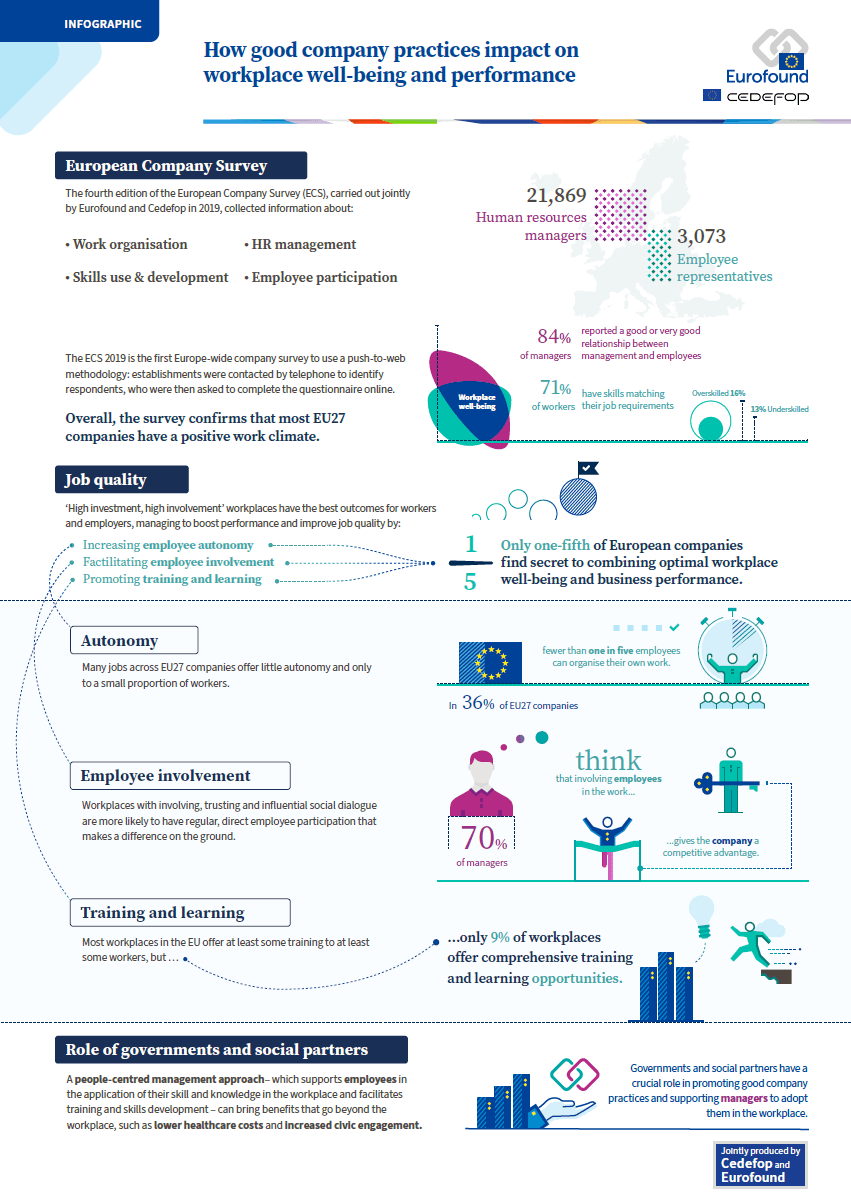
This report is based on the fourth edition of the European Company Survey (ECS), which was carried out jointly by Eurofound and Cedefop in 2019. It describes a wide range of practices and strategies implemented by European companies in terms of work organisation, human resource management, skills use and skills development, and employee voice. The report shows how these practices are combined and how the resulting ‘bundles of practices’ are associated with two outcomes beneficial to employees and employers: workplace well-being and establishment performance.
The analysis finds that the establishments that are most likely to generate this win–win outcome are those that combine a high degree of worker autonomy, a balanced motivational strategy, a comprehensive training and learning strategy, and high levels of direct employee involvement in decision-making, as well as offering managerial support for these practices. To boost the adoption of employee-oriented practices – particularly in relation to autonomy, skills and employee involvement – managers should be offered appropriate support, as they play a key role in the decision to initiate workplace change. They are also crucial to its success, as they must continuously support the workplace practices implemented.

6 May 2019
Working conditions in a global perspective
Job quality is a major focus of policymakers around the world. For workers, the enterprises that employ them and for societies, there are benefits associated with high-quality jobs, and costs associated with poor-quality jobs. This report – the result of a pioneering project by the International Labour Organization and Eurofound – provides a comparative analysis of job quality covering approximately 1.2 billion workers in Europe, Asia and the Americas. It analyses seven dimensions of job quality: the physical environment, work intensity, working time quality, the social environment, skills and development, prospects, and earnings, finding both important differences and similarities between countries. By analysing positive and negative aspects of job quality in different countries and societies, the report provides a way to look beyond national explanations, to see how some groups of workers are affected more than others and understand the particular issues for women workers around the world – in support of evidence-based policymaking to improve job quality.

17 November 2016
Sixth European Working Conditions Survey – Overview report

Soláthraíonn taighdeoirí Eurofound léargas saineolaithe agus is féidir teagmháil a dhéanamh leo le haghaidh ceisteanna nó fiosrúcháin ó na meáin.
Jorge Cabrita
Senior research managerIs bainisteoir taighde sinsearach é Jorge Cabrita san aonad Saol Oibre, áit a ndéanann sé taighde ar fud na hEorpa a dhearadh, a chomhordú agus a bhainistiú agus a thorthaí a scaipeadh. I measc na bpríomhréimsí saineolais atá aige tá dálaí oibre agus cáilíocht an phoist, am oibre agus cothromaíocht oibre agus saoil, sláinte agus folláine oibrithe, comhionannas inscne, agus tionchair shocheacnamaíocha an aistrithe ghlais. Faoi láthair tá sé i gceannas ar thaighde ar fhorbairtí ama oibre agus ar cháilíocht poist i réigiúin atá leochaileach ó thaobh na haeráide de, agus tá sé i gceannas ar chur i bhfeidhm an tSuirbhé Eorpach ar Dhálaí Oibre 2030. Roimhe sin, bhí sé ina thaighdeoir ag an Ionad Staidéir um Idirghabháil Shóisialta agus ag an Ionad Taighde ar Gheilleagar na Portaingéile, agus d'oibrigh sé mar oiliúnóir agus mar chomhairleoir. Tá BSc san Eacnamaíocht aige agus MSc i gCórais Soch-Eagrúcháin Gníomhaíochta Eacnamaíochta ó Scoil Eacnamaíochta Liospóin.
Agnès Parent-Thirion
Senior research managerIs bainisteoir taighde sinsearach í Agnès Parent-Thirion san aonad Saol Oibre ag Eurofound, ag maoirsiú pleanáil agus forbairt taighde ar choinníollacha oibre. Tá ról lárnach aici sa Suirbhé Eorpach ar Choinníollacha Oibre (EWCS), agus í i gceannas ar ullmhú agus i gceannas ar fhorbairt an cheistneoir do EWCS 2030. I measc a cuid spéiseanna taighde tá cáilíocht poist, eagrú oibre, inscne, rioscaí síceasóisialta agus tionchar na n-aistrithe glasa agus digiteacha ar an saol oibre. Le breis agus dhá scór bliain de thaithí ag obair ar shuirbhéanna comparáideacha Eorpacha, speisialtóireacht Agnès i bhforbairt ceistneoirí, códú gairmeacha, rialú cáilíochta agus anailís. Is céimí í san eacnamaíocht agus sa bhainistíocht ó ollscoileanna Paris IX Dauphine agus Paris I Panthéon Sorbonne agus tá Dioplóma Iarchéime i Staitisticí aici ó Choláiste na Tríonóide, Baile Átha Cliath. Tá oiliúint speisialaithe déanta aici freisin ar cheannaireacht AI (MIT Sloan Executive Education) agus ar mhórdhúshláin an aistrithe (Campus de la Transition). Sula ndeachaigh sí isteach in Eurofound, d'oibrigh sí ar feadh roinnt blianta sa Choimisiún Eorpach.
Tugann an rannán seo rochtain ar an ábhar ar fad a foilsíodh faoin ábhar.