&w=3840&q=90)
What will be the impact of the new Spanish minimum wage?
The Socialist-led Spanish government that emerged last summer had, by the end of 2018, approved a hike in the statutory minimum wage. This was agreed with the left-wing Podemos party as part of an attempt to secure the parliamentary support needed for passing the proposed 2019 budget – although failure to do so resulted in the April election. The new minimum wage came into force on 1 January, rising from 14 monthly payments of €735.90 per year to €900 for those in full-time employment.
The Socialist-led Spanish government that emerged last summer had, by the end of 2018, approved a hike in the statutory minimum wage. This was agreed with the left-wing Podemos party as part of an attempt to secure the parliamentary support needed for passing the proposed 2019 budget – although failure to do so resulted in the April election.
The new minimum wage came into force on 1 January, rising from 14 monthly payments of €735.90 per year to €900 for those in full-time employment. This represented an increase of 22% – the highest in more than four decades in Spain and the most significant among EU countries in 2019.
Publication: Minimum wages in 2019: Annual review
Loss of purchasing power
The rise was framed as a way to counterbalance the loss of purchasing power among those employees who had suffered the worst consequences of the economic crisis. Although there had been prior increases in 2017 and 2018, the rise implemented in 2019 constituted a more determined policy approach.
The crisis had a strong and protracted impact on the Spanish labour market. Real wages had progressed much less among those employees with the lowest wages during the boom, and after the crisis they were worst hit – especially the lowest quintile, whose wages continued to decline until at least 2016 (Figure 1).
Figure 1: Evolution of average real wages in Spain by wage quintile
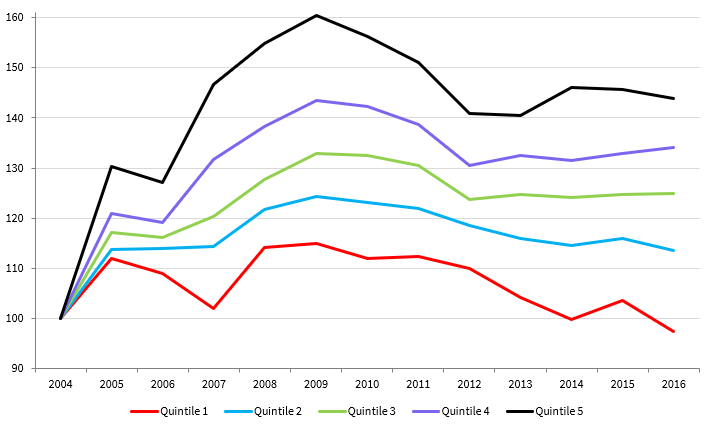
Note: Index: 2004 = 100
Source: EU-SILC
Publication: Income inequalities and employment patterns in Europe before and after the Great Recession
Is the Spanish statutory minimum wage high? It does not seem so, even at its new level (Table 1). Spain ranks eighth among the 22 EU countries that implement a statutory minimum wage and would occupy a more intermediate position if those countries that do not were included, since they have relatively high wage-floors negotiated by the social partners.
Table 1: Statutory minimum wages across EU Member States (prorated over 12 monthly payments)
Carlos Vacas Soriano
Senior research managerCarlos Vacas Soriano est responsable principal de la recherche à l’unité Emploi d’Eurofound. Il travaille sur des sujets liés aux inégalités de salaires et de revenus, au salaire minimum, aux bas salaires, à la qualité de l’emploi, à l’emploi temporaire et à la segmentation, ainsi qu’à la qualité de l’emploi. Avant de rejoindre Eurofound en 2010, il a travaillé comme analyste macroéconomique pour la Commission européenne et comme chercheur sur les marchés du travail européens à la Banque centrale espagnole. Il est titulaire d’un master en études économiques européennes du Collège d’Europe de Bruges et d’un doctorat en économie du travail de l’Université de Salamanque (Docteur Europaeus).
Related content
Minimum wages in 2019 - Annual review
In most EU Member States, reviews of the statutory minimum wage rates spark a great deal of public interest. Such reviews affect the wider workforce, beyond those workers on the statutory minimum wage. Pay rates in collective agreements may be adapted in response to an increase in the minimum wage, affecting lower-paid workers more generally; social benefits may also be affected, making the impact of such revisions even more widespread. This report covers developments in statutory minimum wages in 2018–2019 in the EU and Norway. It looks at the level of minimum wages, how they were set and how they have developed over time in nominal and real terms. It also covers major debates in relation to setting minimum wage levels. While the report focuses on the net remuneration of those receiving the minimum wage, it also documents minimum rates from selected collective agreements in countries without statutory minimum wages as well as minimum wage coverage rates of workers by gender.
 This website is an official website of the European Union.
All official European Union website addresses are in the europa.eu domain.
See all EU institutions and bodies
Fondation européenne pour l’amélioration des conditions de vie et de travail