&w=3840&q=90)
Violence in the workplace: Women and frontline workers face higher risks
Women and frontline workers are most exposed to the risks of adverse social behaviour at work, such as burnout, exhaustion, anxiety and depression. This is according to the European Working Conditions Telephone Survey 2021 (EWCTS). In this data story, we dive into EWCTS data (EU27) to examine the prevalence of adverse social behaviour in the workplace - also known as ‘violence in the workplace’ - and the health and well-being implications it has for those who experience it.
Women more likely to experience adverse social behaviour, particularly unwanted sexual attention
The EWCTS found that, on average, 12.5% of workers in the EU experienced some form of adverse social behaviour at work in 2021; [1] however, the share of women experiencing adverse social behaviour at work was consistently higher than that of men.
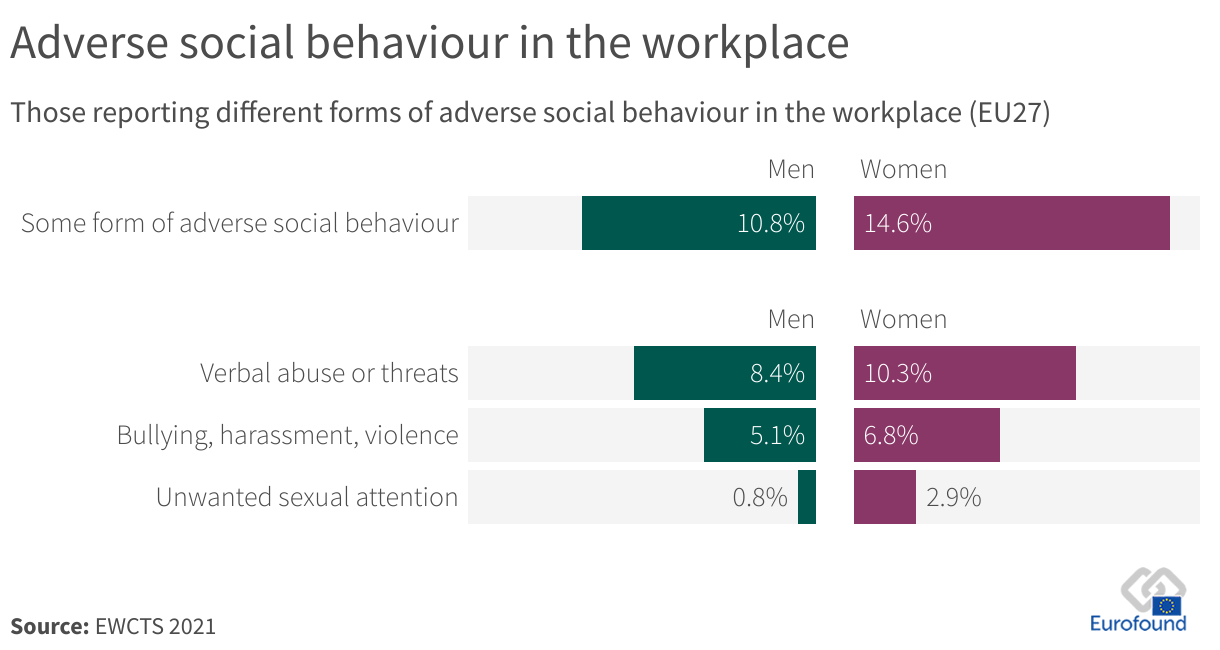
While this is the case for all forms of adverse social behaviour covered in the survey, the gender gap is particularly striking when it comes to unwanted sexual attention.
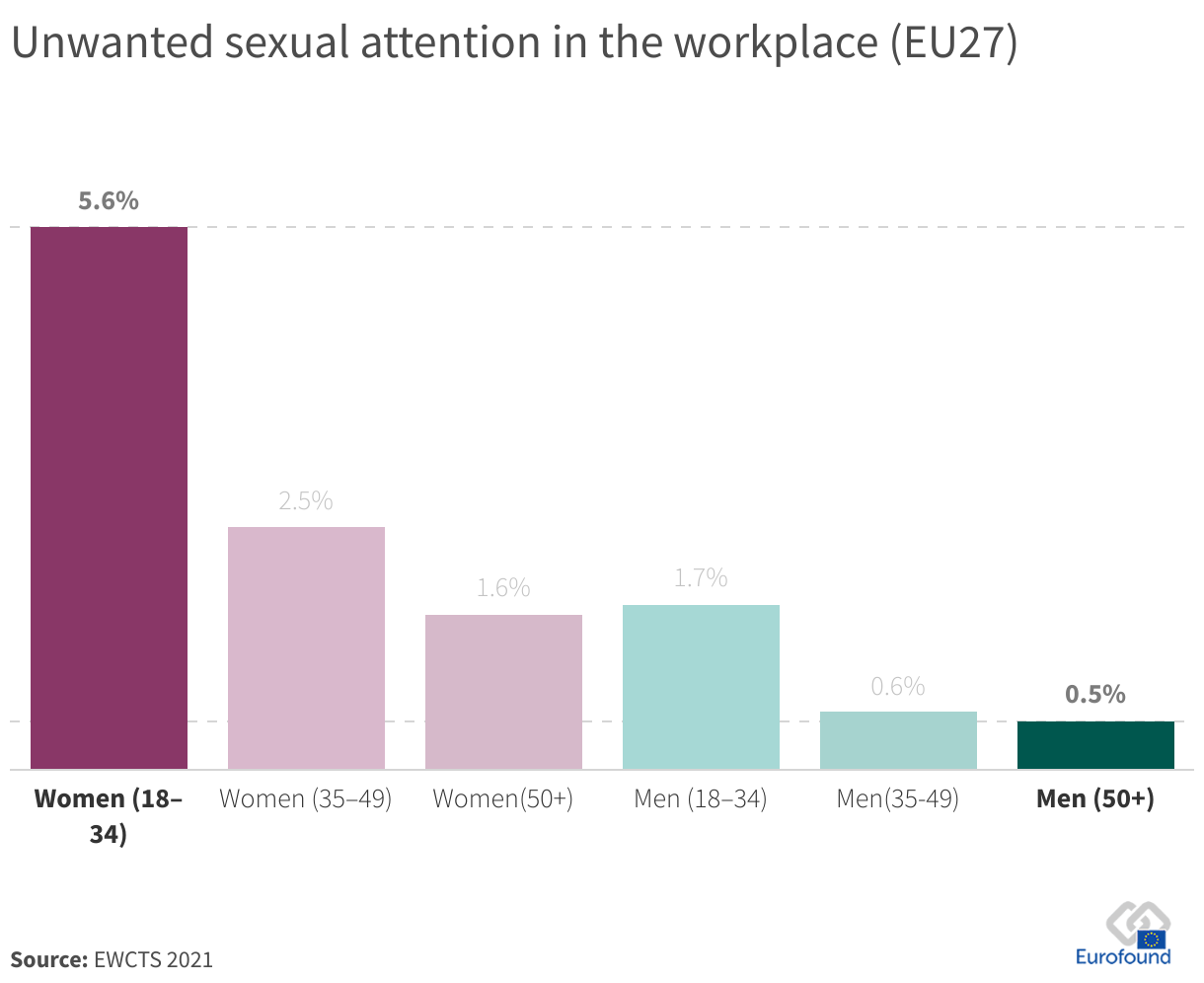
Women are 3.6 times more likely to suffer from unwanted sexual attention than men. What’s more, the likelihood of a young woman (18–34 years) reporting unwanted sexual attention is three times higher than men of the same age, and 10 times higher than the oldest group of men (50+ years).
Women aged 50+ are 3.5 times less likely to report unwanted sexual attention than women aged 18–34 (1.6% compared with 5.6%).
Frontline workers most exposed to adverse social behaviour
While the EWCTS reveals that people who deal with customers are twice as likely to experience adverse social behaviour at work compared to those who don’t, the situation is particularly acute for frontline workers.
Healthcare workers reported up to three times higher levels of unwanted sexual attention than the EU average (5.7% compared with 1.7%). To put this in perspective, just 0.3% of information and communication (IC) professionals reported unwanted sexual attention.
Both healthcare and protective services workers (including fire-fighters, police officers, prison and security guards) reported 2–3 times higher levels of bullying, harassment and violence than the EU average.
A variety of frontline workers reported verbal abuse or threats, some as high as 2.5 times the EU average.
Agnès Parent-Thirion
Senior research managerAgnès Parent-Thirion je višja vodja raziskav v enoti za delovno življenje pri Eurofoundu, ki je zadolžena za načrtovanje, razvoj in izvajanje raziskovalnih projektov o delovnih razmerah, zlasti evropske raziskave o delovnih razmerah (EWCS) in njenih analiz. Odgovorna je za izredno izdajo EWCS 2021 in za pripravo vprašalnika za EWCS 2024. Njeni raziskovalni interesi vključujejo delovne pogoje, kakovost delovnih mest, spremljanje delovnih pogojev, organizacijo dela, spol, prihodnost dela in čas. Že več kot desetletje dela na področju evropskih primerjalnih raziskav na vseh področjih, vključno z oblikovanjem, razvojem vprašalnika, terenskim delom, kontrolo kakovosti in analizo. Diplomirala je iz ekonomije in managementa na univerzah Paris IX Dauphine in Paris I Panthéon na Sorboni ter ima podiplomsko diplomo iz statistike na Trinity College Dublin. Pred kratkim je zaključila spletne tečaje o umetni inteligenci: vodenje na podlagi poizvedb pri MIT Sloan Executive Education in "Les grand enjeux de la transition: re-ouvrir l'horizon, comprendre pour agir" s Campus de la Transition. Preden se je pridružila Eurofoundu, je več let delala v Evropski komisiji.
Related content
Working conditions in the time of COVID-19: Implications for the future
The strict public health restrictions implemented by governments in 2020 to control the COVID-19 pandemic abruptly changed working life and continued to shape it over the two years that followed. Between March and November 2021, over 70,000 interviews were carried out in 36 countries by the European Working Conditions Telephone Survey (EWCTS), a high-quality probability-based survey. The aim was to provide a detailed picture of the working lives of Europeans in that exceptional time.
The report documents the working conditions of Europeans in 2021. It examines variation in job quality and identifies its positive association with well-being, health, work engagement and the financial sustainability of work. It highlights the divergences in the experiences of workers depending on workers’ own attributes and their place in the workforce. From this analysis, the report aims to derive lessons for the future, particularly in relation to the enduring marks on how we work and the implications for work organisation, the quality of work, and the interaction between work and private life.
Job quality is pivotal in addressing today’s workplace and societal challenges
The COVID-19 pandemic has changed the way we live and work. With the lifting of restrictions across the globe, we are now able to examine the many repercussions on the world of work. In particular, the unique demands of the last few years have shone a harsh spotlight on the pressures brought to bear on different jobs and on certain work environments and the stresses associated with different forms of work. The pandemic has made us reassess so many aspects of our working lives. But has it changed the way we think about job quality – its role in ensuring a good working life and, indeed, a good life in general? The European Working Conditions Telephone Survey (EWCTS), a representative survey of Europe’s workers conducted by Eurofound in 2021, provides some answers. This website is an official website of the European Union.
All official European Union website addresses are in the europa.eu domain.
See all EU institutions and bodies
Evropska fundacija za izboljšanje življenjskih in delovnih pogojev