Jakość pracy

Jakość miejsc pracy uzupełnia miary liczby miejsc pracy w celu zapewnienia oceny strategii zatrudnienia. Jakość miejsc pracy to pojęcie wielowymiarowe, w którym różne programy polityczne i dyscypliny kładą nacisk na różne wymiary. W większości badań Eurofound jakość pracy jest mierzona na poziomie samego stanowiska. Obejmuje on cechy stanowiska uchwycone z obiektywnej perspektywy, które można zaobserwować i które są związane z zaspokajaniem potrzeb ludzi związanych z pracą. Składa się na nią wszystkie cechy pracy i zatrudnienia, które, jak udowodniono, mają związek przyczynowy ze zdrowiem i dobrym samopoczuciem. Uwzględniono pozytywne i negatywne cechy miejsc pracy. Wskaźniki te odzwierciedlają zasoby pracy (aspekty fizyczne, psychologiczne, społeczne lub organizacyjne) oraz wymagania zawodowe lub procesy, które na nie wpływają.

Scientists work in the laboratory

Nowe i nadchodzące

Poniżej znajdziesz najnowsze treści na ten temat.

Inny

11 November 2025

Europe’s social model – The key to competitive growth – Background paper
Massimiliano Mascherini
This background paper outlines the context for the issues to be examined at Eurofound’s Foundation Forum 2025. As the global order proves to be increasingly volatile, the European Union itself is undergoing a profound transformation in terms of its socioeconomic and geopolitical landscape. Enhancing competitiveness and ensuring sustainable economic growth are now at the top of the EU agenda.
Raport z badań
W przygotowaniu

December 2025

Job quality and working conditions in the Western Balkans
Johannes Weissand 2 other authors

This report documents working conditions and job quality in the Western Balkans, drawing on data from the 2021 European Working Conditions Telephone Survey. It provides new regional insights into European working conditions and aims to raise awareness among policymakers, social partners, researchers and the wider public in the region of job quality and its importance for workers’ well-being. While the region still lags behind the EU in most job quality indicators, particularly with regard to gender equality in the workplace, the report paints a complex and diverse picture of job quality across various dimensions and countries. A region-specific combination of job demands and job resources found in several dimensions of job quality highlights some common aspects of the region’s work culture. In other cases, differences are more pronounced, even between jobs and workers in culturally close countries. Despite these challenges, many jobs in the Western Balkans demonstrate remarkable resourcefulness. With the right policies, this potential can be realised more effectively.

O tym temacie Jakość pracy

Dowiedz się więcej o tym temacie i jego znaczeniu dla kształtowania polityki UE.

Najważniejsze informacje dla Jakość pracy

To jest wybór najważniejszych wyników dla tego tematu.

3 September 2025

Cyfrowa historia

Trendy w jakości miejsc pracy: pierwsze ustalenia EWCS 2024

EWCS 2024 ujawnia najnowsze trendy w zakresie jakości miejsc pracy w oparciu o siedem wymiarów ram jakości pracy. Ta cyfrowa historia pierwszych ustaleń EWCS zawiera przegląd wstępnej analizy danych EWCS 2024.

30 June 2024

Raport z badań

Job quality side of climate change

Workers will experience the effects of climate change in many ways: job insecurity, changes to their work tasks and responsibilities, and changes in their workplaces that may involve different work practices and the development of new activities and products. Climate change risks are associated with increased exposure to hazards, leading to lower standards of job quality, productivity loss and greater job and work insecurity. Nearly half of workers in the EU will experience profound changes in their job tasks as economies adapt to climate change and climate mitigation strategies are implemented. In addition, work is likely to change as a result of company responses to climate change. These changes in work, while increasing the vulnerability of some workers, offer opportunities to improve some dimensions of job quality. This report outlines the complex relationship between job quality and climate change, including the implication of green tasks in selected sectors.

30 January 2024

Raport z badań

Self-employment in the EU: Job quality and developments in social protection

Ensuring greater social protection for self-employed people has been the subject of much policy debate in recent years. In 2019, the Council of the European Union adopted a recommendation on access to social protection for workers and the self-employed. Sudden reductions in income during the COVID-19 pandemic highlighted the vulnerability of many self-employed workers. Using data from the European Working Conditions Telephone Survey, this report examines the working conditions of different groups of self-employed people. It analyses measures taken at EU Member State level to better protect self-employed individuals against the risks of unemployment, workplace accidents and sickness, and presents lessons learned from measures implemented during the pandemic.

9 October 2023

Krótki opis polityki

Job quality of COVID-19 pandemic essential workers

During the COVID-19 pandemic, a diverse collection of workers ensured the functioning of our societies. In a time of crisis, they maintained access to healthcare, long-term care and other essential goods and services, including food, water, electricity, the internet and waste treatment. These were the COVID-19 pandemic essential, or critical, workers, many of whom risked their physical and mental health by continuing to go to work during the pandemic.

This policy brief investigates the job quality of these critical workers, making use of unique sources of information, including data from the European Working Conditions Telephone Survey 2021, data gathered by correspondents from across the Member States and interviews with EU-level social partner representatives from selected sectors. It examines the experiences of work among critical workers during the pandemic, and highlights imminent challenges to the sustainability of their work. The aim is to discover whether these workers are equipped to support society through future shocks and crises.

26 February 2021

Sztandarowe sprawozdanie

Working conditions and sustainable work: An analysis using the job quality framework

This flagship report summarises the key findings of Eurofound’s research on working conditions conducted over the programming period 2017–2020. It maps the progress achieved since 2000 in improving working conditions and examines whether all workers have benefited equally from positive change. It highlights which groups are the most at risk of experiencing poor working conditions and being left behind. Given the changes in the world of work, emerging challenges for good job quality are identified. The report also provides evidence for measures that could lead to the further improvement of work and the achievement of fair working conditions for all in the EU. The analysis shows that, overall, job quality in the EU is improving, if slowly. Not all workers are benefiting to the same extent, however. Furthermore, gender, age and contractual status have a significant bearing on a person’s working conditions. And while digitalisation helps to address some job quality issues, it also creates new challenges. The COVID-19 pandemic has exacerbated trends, reinforcing concerns and highlighting the importance of achieving job quality for all.

2 March 2020

Raport z badań

Gender equality at work

Gender inequality at work persists across Europe, despite the long standing attention paid and efforts made to tackle it. This Eurofound report presents a closer look at women’s and men’s working conditions, using data from Eurofound’s European Working Conditions Survey (EWCS) and complementing previous Eurofound research on, among other things, working time patterns, work–life balance and workers’ health. Beyond the general differences in the labour market, it highlights many important gaps in men’s and women’s working conditions and job quality which require specific attention. According to the EWCS data, the reduction of gender gaps in those areas showing improvement over the last 5 to 10 years remains limited. European and national strategies aimed at achieving job quality for all, that seek to mainstream gender equality, could help address persistent inequalities between men and women.

12 October 2020

Sztandarowe sprawozdanie

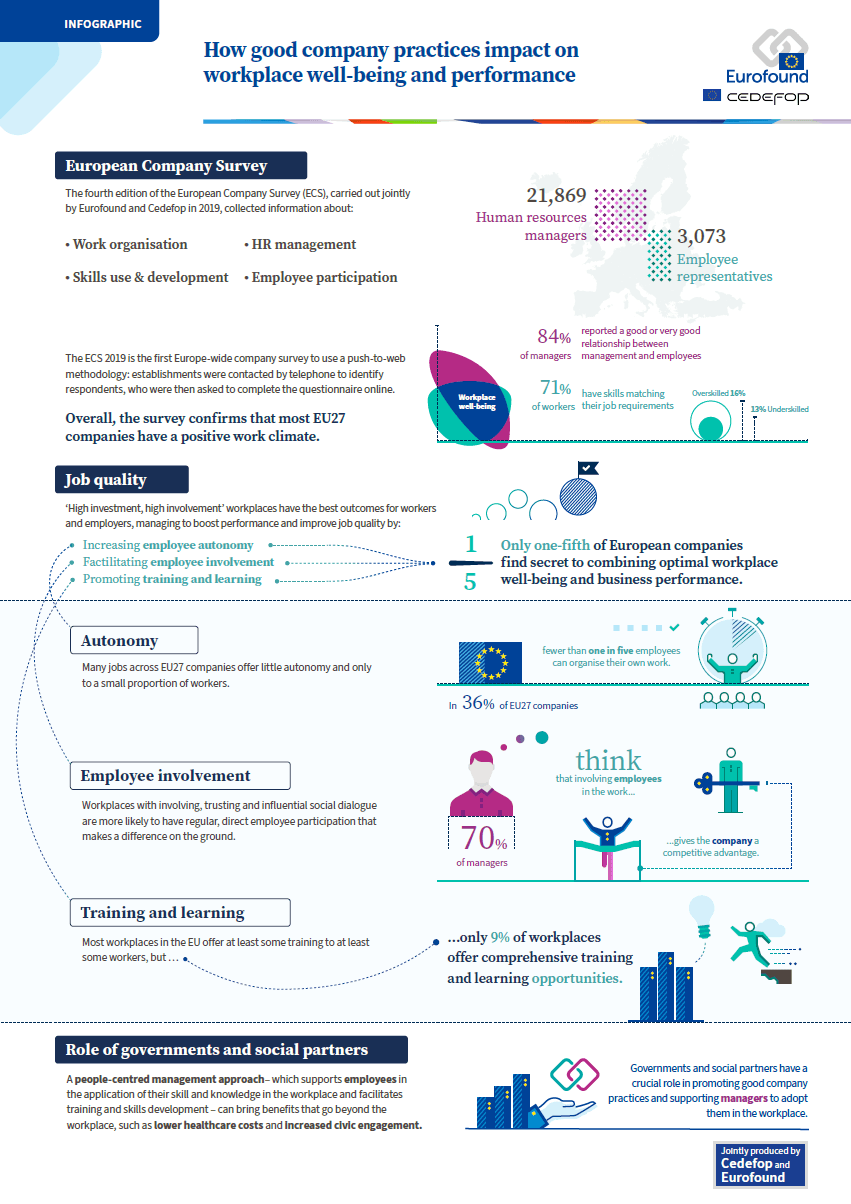
European Company Survey 2019 - Workplace practices unlocking employee potential

This report is based on the fourth edition of the European Company Survey (ECS), which was carried out jointly by Eurofound and Cedefop in 2019. It describes a wide range of practices and strategies implemented by European companies in terms of work organisation, human resource management, skills use and skills development, and employee voice. The report shows how these practices are combined and how the resulting ‘bundles of practices’ are associated with two outcomes beneficial to employees and employers: workplace well-being and establishment performance.

The analysis finds that the establishments that are most likely to generate this win–win outcome are those that combine a high degree of worker autonomy, a balanced motivational strategy, a comprehensive training and learning strategy, and high levels of direct employee involvement in decision-making, as well as offering managerial support for these practices. To boost the adoption of employee-oriented practices – particularly in relation to autonomy, skills and employee involvement – managers should be offered appropriate support, as they play a key role in the decision to initiate workplace change. They are also crucial to its success, as they must continuously support the workplace practices implemented.

6 May 2019

Raport z badań

Working conditions in a global perspective

Job quality is a major focus of policymakers around the world. For workers, the enterprises that employ them and for societies, there are benefits associated with high-quality jobs, and costs associated with poor-quality jobs. This report – the result of a pioneering project by the International Labour Organization and Eurofound – provides a comparative analysis of job quality covering approximately 1.2 billion workers in Europe, Asia and the Americas. It analyses seven dimensions of job quality: the physical environment, work intensity, working time quality, the social environment, skills and development, prospects, and earnings, finding both important differences and similarities between countries. By analysing positive and negative aspects of job quality in different countries and societies, the report provides a way to look beyond national explanations, to see how some groups of workers are affected more than others and understand the particular issues for women workers around the world – in support of evidence-based policymaking to improve job quality.

17 November 2016

Raport z badań

Sixth European Working Conditions Survey – Overview report

The sixth European Working Conditions Survey (EWCS) builds on the lessons learned from the previous five surveys to paint a wide-ranging picture of Europe at work across countries, occupations, sectors and age groups. The analysis explores the findings using seven indices of job quality – physical environment, work intensity, working time quality, social environment, skills and discretion, prospects and earnings – and categorises workers into five typical job quality profiles.

Eksperci na temat Jakość pracy

Naukowcy Eurofound dostarczają fachowej wiedzy i można się z nimi skontaktować w celu zadania pytań lub zapytań mediów.

Jorge Cabrita

Senior research manager
Working life research

Jorge Cabrita is a senior research manager in the Working Life unit. He is responsible for formulating, coordinating and managing European-wide research, and promoting the dissemination of findings in the areas of working conditions and industrial relations. His main research areas of interest include working conditions and job quality, working time and work–life balance, workers’ health and well-being, gender equality and the socioeconomic impacts of the transition to a climate-neutral economy. He is currently leading research on working time developments and on social dialogue and collective bargaining during the COVID-19 pandemic. Previously, he worked as a researcher at the Centre for Studies for Social Intervention and at the Research Centre on the Portuguese Economy of the Lisbon School of Economics, and as a trainer and consultant in the areas of strategic management, organisational communication, leadership and team building. He holds a BSc in Economics and an MSc in Socio-Organisational Systems of Economic Activity from the Lisbon School of Economics.

Agnès Parent-Thirion

Senior research manager
Working life research

Agnès Parent-Thirion jest starszym kierownikiem ds. badań naukowych w dziale ds. życia zawodowego w Eurofound, którego zadaniem jest planowanie, opracowywanie i wdrażanie projektów badawczych dotyczących warunków pracy, w szczególności europejskiego badania warunków pracy (EWCS) i jego analiz. Jest odpowiedzialna za nadzwyczajną edycję EWCS 2021 oraz za przygotowanie kwestionariusza na EWCS 2024. Jej zainteresowania badawcze obejmują warunki pracy, jakość pracy, monitorowanie warunków pracy, organizację pracy, płeć, przyszłość pracy i czasu. Od ponad dekady zajmuje się europejskimi badaniami porównawczymi, we wszystkich aspektach, w tym projektowaniu, opracowywaniu kwestionariuszy, pracach terenowych, kontroli jakości i analizie. Ukończyła ekonomię i zarządzanie na uniwersytetach Paris IX Dauphine i Paris I Panthéon Sorbonne, a także ukończyła studia podyplomowe ze statystyki w Trinity College w Dublinie. Niedawno ukończyła kursy online na temat sztucznej inteligencji: przywództwo oparte na dociekaniu w MIT Sloan Executive Education oraz "Les grand enjeux de la transition: re-ouvrir l'horizon, comprendre pour agir" w Campus de la Transition. Przed dołączeniem do Eurofound przez wiele lat pracowała w Komisji Europejskiej.

Cała zawartość dla Jakość pracy

Ta sekcja zapewnia dostęp do całej zawartości, która została opublikowana na dany temat.

Flag of the European UnionThis website is an official website of the European Union.
How do I know?
European Foundation for the Improvement of Living and Working Conditions
The tripartite EU agency providing knowledge to assist in the development of better social, employment and work-related policies