&w=3840&q=90)
Qualità del lavoro
La qualità del lavoro integra le misure della quantità di lavoro per fornire una valutazione della strategia per l'occupazione. La qualità del lavoro è un concetto multidimensionale in cui diverse agende politiche e discipline enfatizzano dimensioni diverse. Nella maggior parte delle ricerche di Eurofound, la qualità del lavoro è misurata a livello del lavoro. Include caratteristiche del lavoro catturate da una prospettiva oggettiva, che possono essere osservate e sono correlate al soddisfacimento delle esigenze delle persone dal lavoro. È costituito da tutte le caratteristiche del lavoro e dell'occupazione che hanno dimostrato di avere una relazione causale con la salute e il benessere. Sono incluse le caratteristiche positive e negative dei lavori. Questi indicatori riflettono le risorse lavorative (aspetti fisici, psicologici, sociali o organizzativi) e le richieste di lavoro, o i processi che le influenzano.
Trova i contenuti più recenti su questo tema qui di seguito.
Rompere il ciclo: migliorare la qualità del lavoro può risolvere la carenza di manodopera nell'UE?
In tutta l'UE, la carenza di manodopera colpisce quasi tutte le occupazioni individuate, specialmente quelle che affrontano ambienti di lavoro difficili e scarsa qualità del tempo di lavoro. Individuando le lacune di qualità del lavoro legate a salute e benessere, responsabili politici e datori di lavoro possono rendere questi posti di lavoro più attraenti e rompere il ciclo della carenza.Settore IT al centro: evoluzione della forza lavoro digitale dell'UE
Il settore ICT sta guidando la digitalizzazione e l'adozione dell'IA in tutta Europa, eppure la carenza di manodopera qualificata ne sta frenando la crescita. Questo rapporto esamina l'occupazione e le condizioni di lavoro per gli specialisti ICT e le sfide che stanno definendo uno dei settori più critici dell'UE.Gestione algoritmica nei luoghi di lavoro europei: implicazioni per l'organizzazione e le condizioni di lavoro
Questo studio presenta un'analisi secondaria dei dati della Settima Indagine Europea sulle Condizioni di Lavoro di Eurofound (EWCS 2024) che esplora la prevalenza delle tecnologie digitali nei luoghi di lavoro moderni e la diffusione delle pratiche manageriali algoritmiche. Collegando l'esposizione segnalata dei lavoratori a programmi informatici che monitorano le prestazioni, assegnano compiti e programmano il lavoro con indicatori di qualità del lavoro, l'analisi valuta come la tecnologia rimodella il lavoro. Identifica inoltre profili di lavoratori distinti in base ai modelli di utilizzo della tecnologia digitale e alle caratteristiche associate a ciascun profilo. I risultati guideranno l'elaborazione delle politiche volte a promuovere posti di lavoro di alta qualità in ambienti di lavoro sempre più digitali.Eurofound mira a consolidare la posizione della sua indagine europea sulle condizioni di lavoro (EWCS) come strumento importante per l'analisi comparativa della qualità del lavoro nell'Unione europea e oltre, contribuendo allo sviluppo di politiche nel settore della qualità del lavoro. I dati sono stati utilizzati per svolgere ulteriori ricerche su vari temi legati alla qualità del lavoro, tra cui la qualità del lavoro in diverse situazioni lavorative, la qualità del lavoro di diversi gruppi nel mercato del lavoro, l'impatto della qualità del lavoro sulla qualità della vita lavorativa e un'analisi approfondita delle singole dimensioni della qualità del lavoro. Le indagini sulle imprese europee (ECS) esaminano anche le diverse dimensioni della qualità del lavoro per i lavoratori e i datori di lavoro. Recenti ricerche hanno anche esaminato la qualità del lavoro in una prospettiva globale.
La qualità del lavoro e il suo miglioramento sono un'importante preoccupazione politica, in quanto i posti di lavoro di qualità sono fondamentali per una maggiore partecipazione alla forza lavoro, un maggiore benessere e una maggiore performance economica. Anche la qualità del lavoro è un elemento chiave per rendere il lavoro sostenibile e consentire ai lavoratori di rimanere motivati a rimanere al lavoro più a lungo. È fondamentale per l'agenda dell'ILO per il lavoro dignitoso, la strategia dell'OCSE per l'occupazione e le politiche dell'Unione europea in materia di qualità del lavoro volte a creare nuovi e migliori posti di lavoro. Per i lavoratori, per le imprese e le organizzazioni che li impiegano e per la società, vi sono benefici associati a posti di lavoro di alta qualità e costi associati a posti di lavoro di scarsa qualità.
Nel 2025 la Commissione europea prevede di presentare una tabella di marcia per l'occupazione di qualità in collaborazione con le parti sociali, con l'obiettivo di "sostenere salari equi, buone condizioni di lavoro, formazione e transizioni occupazionali eque per i lavoratori subordinati e autonomi. Questa iniziativa sostiene l'impegno a rafforzare la competitività dell'UE, come indicato nella bussola per la competitività, e a creare posti di lavoro di qualità.
Priorità della Commissione: sostenere le persone, rafforzare le nostre società e il nostro modello socialeopens in new tab
Organizzazione Internazionale del Lavoro (ILO): Lavoro dignitosoopens in new tab
Organizzazione per la cooperazione e lo sviluppo economico (OCSE): Strategia dell'OCSE per l'occupazioneopens in new tab
Commissione europea: Strategia europea per l'occupazioneopens in new tab
Questa è una selezione delle pubblicazioni più importanti su questo tema.
3 September 2025
Tendenze nella qualità del lavoro: i primi risultati dell'EWCS 2024

30 June 2024
Job quality side of climate change
Workers will experience the effects of climate change in many ways: job insecurity, changes to their work tasks and responsibilities, and changes in their workplaces that may involve different work practices and the development of new activities and products. Climate change risks are associated with increased exposure to hazards, leading to lower standards of job quality, productivity loss and greater job and work insecurity. Nearly half of workers in the EU will experience profound changes in their job tasks as economies adapt to climate change and climate mitigation strategies are implemented. In addition, work is likely to change as a result of company responses to climate change. These changes in work, while increasing the vulnerability of some workers, offer opportunities to improve some dimensions of job quality. This report outlines the complex relationship between job quality and climate change, including the implication of green tasks in selected sectors.

30 January 2024
Self-employment in the EU: Job quality and developments in social protection
Ensuring greater social protection for self-employed people has been the subject of much policy debate in recent years. In 2019, the Council of the European Union adopted a recommendation on access to social protection for workers and the self-employed. Sudden reductions in income during the COVID-19 pandemic highlighted the vulnerability of many self-employed workers. Using data from the European Working Conditions Telephone Survey, this report examines the working conditions of different groups of self-employed people. It analyses measures taken at EU Member State level to better protect self-employed individuals against the risks of unemployment, workplace accidents and sickness, and presents lessons learned from measures implemented during the pandemic.

9 October 2023
Job quality of COVID-19 pandemic essential workers
During the COVID-19 pandemic, a diverse collection of workers ensured the functioning of our societies. In a time of crisis, they maintained access to healthcare, long-term care and other essential goods and services, including food, water, electricity, the internet and waste treatment. These were the COVID-19 pandemic essential, or critical, workers, many of whom risked their physical and mental health by continuing to go to work during the pandemic.
This policy brief investigates the job quality of these critical workers, making use of unique sources of information, including data from the European Working Conditions Telephone Survey 2021, data gathered by correspondents from across the Member States and interviews with EU-level social partner representatives from selected sectors. It examines the experiences of work among critical workers during the pandemic, and highlights imminent challenges to the sustainability of their work. The aim is to discover whether these workers are equipped to support society through future shocks and crises.

26 February 2021
Working conditions and sustainable work: An analysis using the job quality framework
This flagship report summarises the key findings of Eurofound’s research on working conditions conducted over the programming period 2017–2020. It maps the progress achieved since 2000 in improving working conditions and examines whether all workers have benefited equally from positive change. It highlights which groups are the most at risk of experiencing poor working conditions and being left behind. Given the changes in the world of work, emerging challenges for good job quality are identified. The report also provides evidence for measures that could lead to the further improvement of work and the achievement of fair working conditions for all in the EU. The analysis shows that, overall, job quality in the EU is improving, if slowly. Not all workers are benefiting to the same extent, however. Furthermore, gender, age and contractual status have a significant bearing on a person’s working conditions. And while digitalisation helps to address some job quality issues, it also creates new challenges. The COVID-19 pandemic has exacerbated trends, reinforcing concerns and highlighting the importance of achieving job quality for all.

2 March 2020
Gender equality at work
Gender inequality at work persists across Europe, despite the long standing attention paid and efforts made to tackle it. This Eurofound report presents a closer look at women’s and men’s working conditions, using data from Eurofound’s European Working Conditions Survey (EWCS) and complementing previous Eurofound research on, among other things, working time patterns, work–life balance and workers’ health. Beyond the general differences in the labour market, it highlights many important gaps in men’s and women’s working conditions and job quality which require specific attention. According to the EWCS data, the reduction of gender gaps in those areas showing improvement over the last 5 to 10 years remains limited. European and national strategies aimed at achieving job quality for all, that seek to mainstream gender equality, could help address persistent inequalities between men and women.

12 October 2020
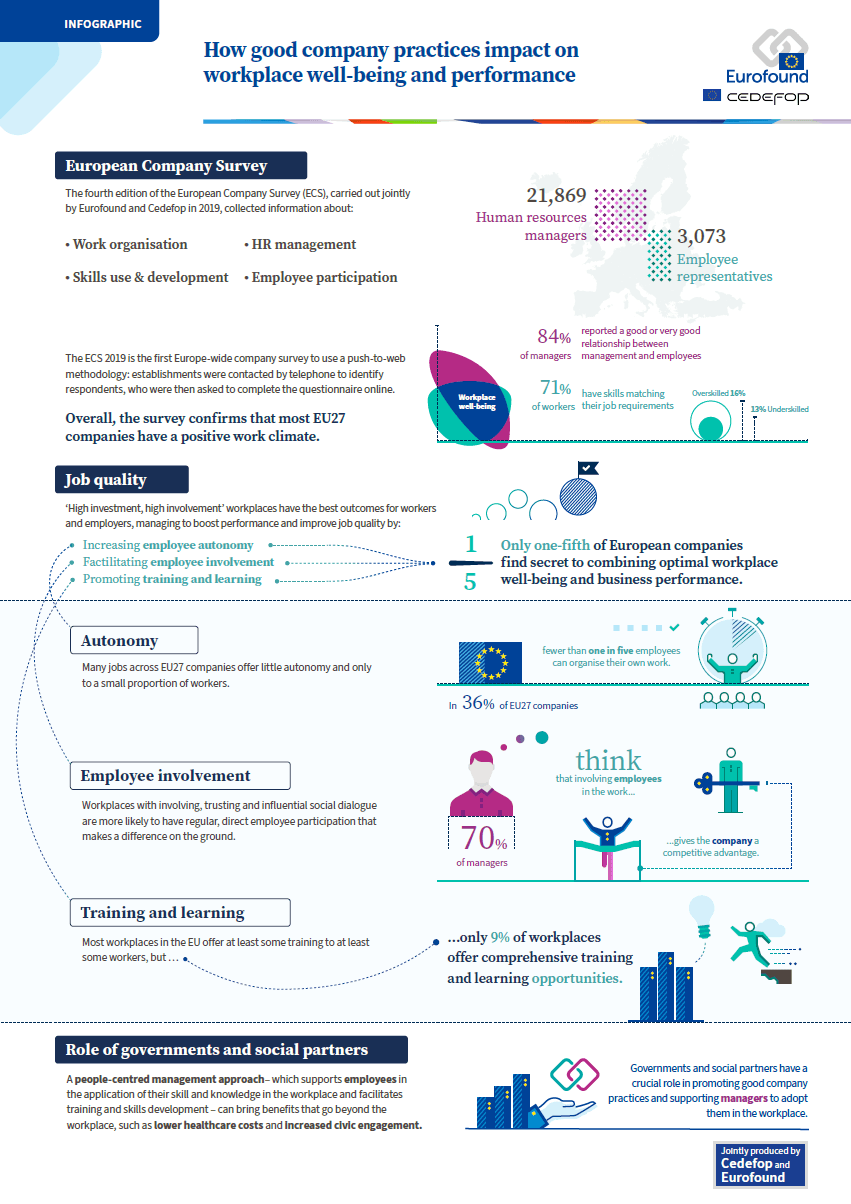
European Company Survey 2019 - Workplace practices unlocking employee potential
This report is based on the fourth edition of the European Company Survey (ECS), which was carried out jointly by Eurofound and Cedefop in 2019. It describes a wide range of practices and strategies implemented by European companies in terms of work organisation, human resource management, skills use and skills development, and employee voice. The report shows how these practices are combined and how the resulting ‘bundles of practices’ are associated with two outcomes beneficial to employees and employers: workplace well-being and establishment performance.
The analysis finds that the establishments that are most likely to generate this win–win outcome are those that combine a high degree of worker autonomy, a balanced motivational strategy, a comprehensive training and learning strategy, and high levels of direct employee involvement in decision-making, as well as offering managerial support for these practices. To boost the adoption of employee-oriented practices – particularly in relation to autonomy, skills and employee involvement – managers should be offered appropriate support, as they play a key role in the decision to initiate workplace change. They are also crucial to its success, as they must continuously support the workplace practices implemented.

6 May 2019
Working conditions in a global perspective
Job quality is a major focus of policymakers around the world. For workers, the enterprises that employ them and for societies, there are benefits associated with high-quality jobs, and costs associated with poor-quality jobs. This report – the result of a pioneering project by the International Labour Organization and Eurofound – provides a comparative analysis of job quality covering approximately 1.2 billion workers in Europe, Asia and the Americas. It analyses seven dimensions of job quality: the physical environment, work intensity, working time quality, the social environment, skills and development, prospects, and earnings, finding both important differences and similarities between countries. By analysing positive and negative aspects of job quality in different countries and societies, the report provides a way to look beyond national explanations, to see how some groups of workers are affected more than others and understand the particular issues for women workers around the world – in support of evidence-based policymaking to improve job quality.

17 November 2016
Sixth European Working Conditions Survey – Overview report

I ricercatori di Eurofound forniscono approfondimenti esperti e possono essere contattati per domande o richieste dei media.
Jorge Cabrita
Senior research managerJorge Cabrita è senior research manager nell'unità Working Life, dove progetta, coordina e gestisce la ricerca a livello europeo e ne diffonde i risultati. Le sue principali aree di competenza includono condizioni di lavoro e qualità del lavoro, orario lavorativo ed equilibrio tra lavoro e vita privata, salute e benessere dei lavoratori, uguaglianza di genere e impatti socioeconomici della transizione verde. Attualmente guida la ricerca sullo sviluppo del tempo di lavoro e la qualità del lavoro nelle regioni vulnerabili al clima, e co-guida l'implementazione dell'European Working Conditions Survey 2030. In precedenza è stato ricercatore presso il Centre for Studies for Social Intervention e il Research Centre on the Portuguese Economy, lavorando come formatore e consulente. Ha conseguito una laurea in Economia e un MSc in Sistemi Socio-Organizzativi di Attività Economica presso la Lisbon School of Economics.
Agnès Parent-Thirion
Senior research managerAgnès Parent-Thirion è senior research manager nell'unità Working Life di Eurofound, supervisionando la pianificazione e lo sviluppo della ricerca sulle condizioni di lavoro. Svolge un ruolo chiave nell'European Working Conditions Survey (EWCS), co-guidando la preparazione e lo sviluppo del questionario per EWCS 2030. I suoi interessi di ricerca includono qualità del lavoro, organizzazione del lavoro, genere, rischi psicosociali e l'impatto delle transizioni green e digital sulla vita lavorativa. Con oltre due decenni di esperienza in indagini comparative europee, Agnès è specializzata nello sviluppo di questionari, codifica delle professioni, controllo qualità e analisi. È laureata in economia e management presso le università Paris IX Dauphine e Paris I Panthéon Sorbonne e possiede un Diploma Post-Laurea in Statistica presso il Trinity College Dublin. Ha inoltre completato una formazione specializzata sulla leadership in IA (MIT Sloan Executive Education) e sulle principali sfide della transizione (Campus de la Transition). Prima di entrare in Eurofound, ha lavorato per diversi anni nella Commissione Europea.
Questa sezione fornisce l'accesso a tutti i contenuti pubblicati sul tema.


