&w=3840&q=90)
Kvalita práce
Kvalita pracovných miest dopĺňa ukazovatele kvantity pracovných miest s cieľom poskytnúť hodnotenie stratégie zamestnanosti. Kvalita pracovných miest je viacrozmerný pojem, v ktorom rôzne politické programy a disciplíny zdôrazňujú rôzne rozmery. Vo väčšine výskumov nadácie Eurofound sa kvalita pracovných miest meria na úrovni pracovného miesta. Zahŕňa charakteristiky práce zachytené z objektívnej perspektívy, ktoré možno pozorovať a súvisia s uspokojovaním potrieb ľudí z práce. Skladá sa zo všetkých charakteristík práce a zamestnania, ktoré preukázateľne súvisia so zdravím a pohodou. Zahrnuté sú pozitívne a negatívne vlastnosti pracovných miest. Tieto ukazovatele odrážajú pracovné zdroje (fyzické, psychologické, sociálne alebo organizačné aspekty) a pracovné požiadavky alebo procesy, ktoré ich ovplyvňujú.
Najnovší obsah k tejto téme nájdete nižšie.
Prelomenie tohto cyklu: Môže zlepšenie kvality pracovných miest vyriešiť nedostatok pracovnej sily v EÚ?
V celej EÚ postihujú nedostatok pracovnej sily takmer všetky identifikované povolania, najmä tie, ktoré čelia náročnému pracovnému prostrediu a zlej kvalite pracovného času. Identifikovaním rozdielov v kvalite zamestnania súvisiacich so zdravím a pohodou môžu tvorcovia politík a zamestnávatelia tieto pracovné miesta spraviť atraktívnejšími a prelomiť cyklus nedostatku.IT sektor v centre pozornosti: Vývoj digitálnej pracovnej sily EÚ
ICT sektor poháňa digitalizáciu a prijatie AI v celej Európe, no nedostatok kvalifikovanej pracovnej sily brzdí jeho rast. Táto správa skúma zamestnanosť a pracovné podmienky pre ICT špecialistov a výzvy, ktoré formujú jeden z najkritickejších sektorov EÚ.Algoritmický manažment na európskych pracoviskách: Dôsledky pre organizáciu práce a pracovné podmienky
Táto štúdia predstavuje sekundárnu analýzu údajov zo siedmeho európskeho prieskumu pracovných podmienok Eurofoundu (EWCS 2024), ktorá skúma rozšírenosť digitálnych technológií na moderných pracoviskách a šírenie algoritmických manažérskych praktík. Prepojením nahlásených skúseností pracovníkov s počítačovými programami, ktoré monitorujú výkon, prideľujú úlohy a rozvrhujú prácu, s ukazovateľmi kvality práce, analýza hodnotí, ako technológie pretvárajú prácu. Identifikuje tiež odlišné profily pracovníkov na základe vzorcov používania digitálnych technológií a charakteristík spojených s každým profilom. Zistenia budú informovať tvorbu politík zameraných na podporu kvalitných pracovných miest v čoraz digitálnejších pracoviskoch.Cieľom nadácie Eurofound je upevniť pozíciu svojho Európskeho prieskumu pracovných podmienok (EWCS) ako dôležitého nástroja na referenčné porovnávanie kvality pracovných miest v Európskej únii a mimo nej, čo prispieva k rozvoju politiky v oblasti kvality práce. Údaje boli použité na vykonanie ďalšieho výskumu rôznych tém súvisiacich s kvalitou pracovných miest vrátane kvality pracovných miest v rôznych pracovných situáciách, kvality pracovných miest rôznych skupín na trhu práce, vplyvu kvality pracovných miest na kvalitu pracovného života a hĺbkovej analýzy jednotlivých dimenzií kvality pracovných miest. Európske prieskumy spoločností (ECS) sa zameriavajú aj na rôzne rozmery kvality pracovných miest pre pracovníkov a zamestnávateľov. Nedávny výskum sa zameral aj na kvalitu pracovných miest z globálnej perspektívy.
Kvalita pracovných miest a jej zlepšovanie sú dôležitým politickým záujmom, pretože kvalitné pracovné miesta sú kľúčové pre vyššiu účasť pracovnej sily, vyšší blahobyt a vyššiu hospodársku výkonnosť. Kvalita pracovných miest je tiež kľúčovým prvkom udržateľnosti práce a umožňuje pracovníkom zostať motivovaní zostať v práci dlhšie. Je ústredným prvkom programu dôstojnej práce MOP, stratégie OECD v oblasti zamestnanosti a politík Európskej únie v oblasti kvality práce s cieľom vytvárať viac a lepších pracovných miest. Pre pracovníkov, pre podniky a organizácie, ktoré ich zamestnávajú, a pre spoločnosti, sú výhody spojené s vysokokvalitnými pracovnými miestami a náklady spojené s nekvalitnými pracovnými miestami.
V roku 2025 plánuje Európska komisia v spolupráci so sociálnymi partnermi predložiť plán kvalitných pracovných miest s cieľom "podporiť spravodlivé mzdy, dobré pracovné podmienky, odbornú prípravu a spravodlivé zmeny zamestnania pre pracovníkov a samostatne zárobkovo činné osoby. Táto iniciatíva podporuje úsilie o posilnenie konkurencieschopnosti EÚ, ako sa uvádza v Kompase konkurencieschopnosti, a o vytváranie kvalitných pracovných miest.
Priorita Komisie: Podpora ľudí, posilnenie našej spoločnosti a nášho sociálneho modeluopens in new tab
Medzinárodná organizácia práce (MOP): Dôstojná prácaopens in new tab
Organizácia pre hospodársku spoluprácu a rozvoj (OECD): Stratégia OECD pre zamestnanosťopens in new tab
Európska komisia: Európska stratégia zamestnanostiopens in new tab
Toto je výber najdôležitejších poznatkov pre túto tému.
3 September 2025
Trendy v kvalite pracovných miest: prvé zistenia EWCS 2024

30 June 2024
Job quality side of climate change
Workers will experience the effects of climate change in many ways: job insecurity, changes to their work tasks and responsibilities, and changes in their workplaces that may involve different work practices and the development of new activities and products. Climate change risks are associated with increased exposure to hazards, leading to lower standards of job quality, productivity loss and greater job and work insecurity. Nearly half of workers in the EU will experience profound changes in their job tasks as economies adapt to climate change and climate mitigation strategies are implemented. In addition, work is likely to change as a result of company responses to climate change. These changes in work, while increasing the vulnerability of some workers, offer opportunities to improve some dimensions of job quality. This report outlines the complex relationship between job quality and climate change, including the implication of green tasks in selected sectors.

30 January 2024
Self-employment in the EU: Job quality and developments in social protection
Ensuring greater social protection for self-employed people has been the subject of much policy debate in recent years. In 2019, the Council of the European Union adopted a recommendation on access to social protection for workers and the self-employed. Sudden reductions in income during the COVID-19 pandemic highlighted the vulnerability of many self-employed workers. Using data from the European Working Conditions Telephone Survey, this report examines the working conditions of different groups of self-employed people. It analyses measures taken at EU Member State level to better protect self-employed individuals against the risks of unemployment, workplace accidents and sickness, and presents lessons learned from measures implemented during the pandemic.

9 October 2023
Job quality of COVID-19 pandemic essential workers
During the COVID-19 pandemic, a diverse collection of workers ensured the functioning of our societies. In a time of crisis, they maintained access to healthcare, long-term care and other essential goods and services, including food, water, electricity, the internet and waste treatment. These were the COVID-19 pandemic essential, or critical, workers, many of whom risked their physical and mental health by continuing to go to work during the pandemic.
This policy brief investigates the job quality of these critical workers, making use of unique sources of information, including data from the European Working Conditions Telephone Survey 2021, data gathered by correspondents from across the Member States and interviews with EU-level social partner representatives from selected sectors. It examines the experiences of work among critical workers during the pandemic, and highlights imminent challenges to the sustainability of their work. The aim is to discover whether these workers are equipped to support society through future shocks and crises.

26 February 2021
Working conditions and sustainable work: An analysis using the job quality framework
This flagship report summarises the key findings of Eurofound’s research on working conditions conducted over the programming period 2017–2020. It maps the progress achieved since 2000 in improving working conditions and examines whether all workers have benefited equally from positive change. It highlights which groups are the most at risk of experiencing poor working conditions and being left behind. Given the changes in the world of work, emerging challenges for good job quality are identified. The report also provides evidence for measures that could lead to the further improvement of work and the achievement of fair working conditions for all in the EU. The analysis shows that, overall, job quality in the EU is improving, if slowly. Not all workers are benefiting to the same extent, however. Furthermore, gender, age and contractual status have a significant bearing on a person’s working conditions. And while digitalisation helps to address some job quality issues, it also creates new challenges. The COVID-19 pandemic has exacerbated trends, reinforcing concerns and highlighting the importance of achieving job quality for all.

2 March 2020
Gender equality at work
Gender inequality at work persists across Europe, despite the long standing attention paid and efforts made to tackle it. This Eurofound report presents a closer look at women’s and men’s working conditions, using data from Eurofound’s European Working Conditions Survey (EWCS) and complementing previous Eurofound research on, among other things, working time patterns, work–life balance and workers’ health. Beyond the general differences in the labour market, it highlights many important gaps in men’s and women’s working conditions and job quality which require specific attention. According to the EWCS data, the reduction of gender gaps in those areas showing improvement over the last 5 to 10 years remains limited. European and national strategies aimed at achieving job quality for all, that seek to mainstream gender equality, could help address persistent inequalities between men and women.

12 October 2020
European Company Survey 2019 - Workplace practices unlocking employee potential
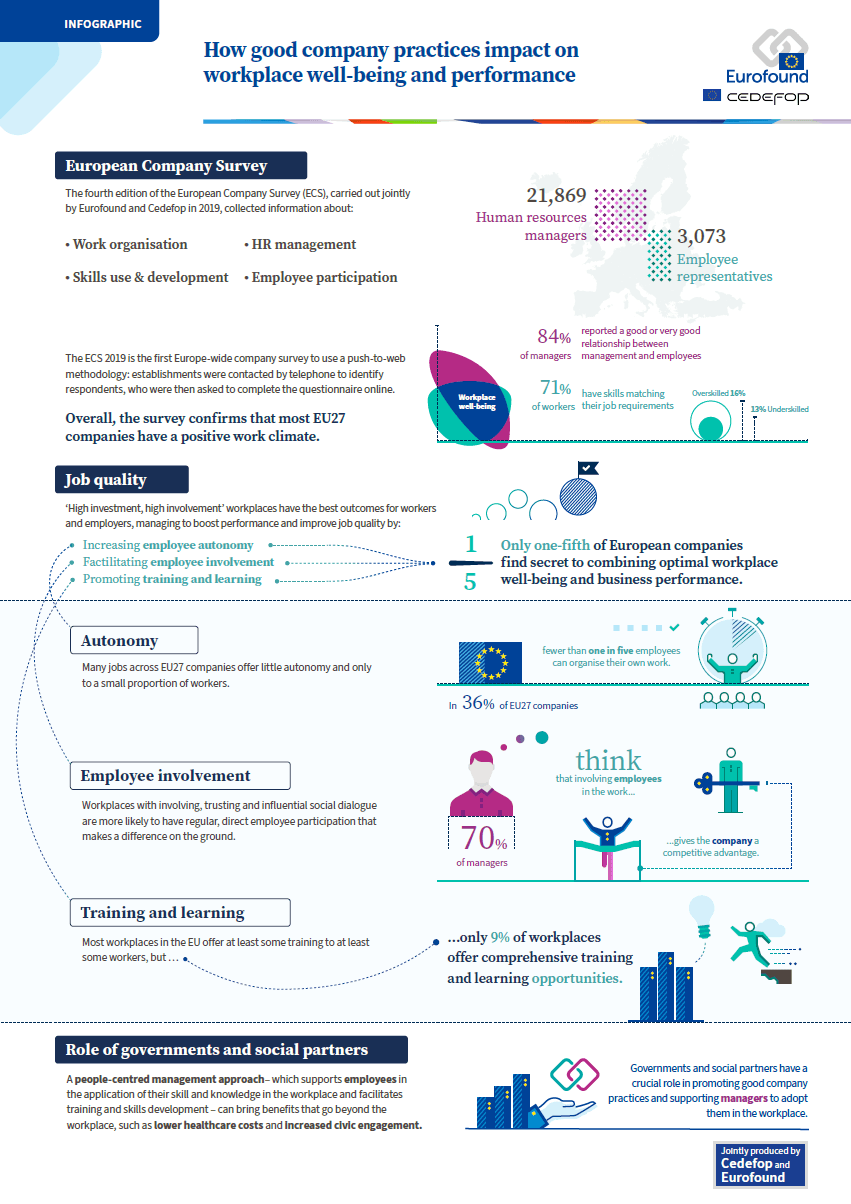
This report is based on the fourth edition of the European Company Survey (ECS), which was carried out jointly by Eurofound and Cedefop in 2019. It describes a wide range of practices and strategies implemented by European companies in terms of work organisation, human resource management, skills use and skills development, and employee voice. The report shows how these practices are combined and how the resulting ‘bundles of practices’ are associated with two outcomes beneficial to employees and employers: workplace well-being and establishment performance.
The analysis finds that the establishments that are most likely to generate this win–win outcome are those that combine a high degree of worker autonomy, a balanced motivational strategy, a comprehensive training and learning strategy, and high levels of direct employee involvement in decision-making, as well as offering managerial support for these practices. To boost the adoption of employee-oriented practices – particularly in relation to autonomy, skills and employee involvement – managers should be offered appropriate support, as they play a key role in the decision to initiate workplace change. They are also crucial to its success, as they must continuously support the workplace practices implemented.

6 May 2019
Working conditions in a global perspective
Job quality is a major focus of policymakers around the world. For workers, the enterprises that employ them and for societies, there are benefits associated with high-quality jobs, and costs associated with poor-quality jobs. This report – the result of a pioneering project by the International Labour Organization and Eurofound – provides a comparative analysis of job quality covering approximately 1.2 billion workers in Europe, Asia and the Americas. It analyses seven dimensions of job quality: the physical environment, work intensity, working time quality, the social environment, skills and development, prospects, and earnings, finding both important differences and similarities between countries. By analysing positive and negative aspects of job quality in different countries and societies, the report provides a way to look beyond national explanations, to see how some groups of workers are affected more than others and understand the particular issues for women workers around the world – in support of evidence-based policymaking to improve job quality.

17 November 2016
Sixth European Working Conditions Survey – Overview report

Výskumníci nadácie Eurofound poskytujú odborné poznatky a možno ich kontaktovať s otázkami alebo so žiadosťami od médií.
Jorge Cabrita
Senior research managerJorge Cabrita je senior manažér výskumu v jednotke Working Life, kde navrhuje, koordinuje a riadi celoeurópsky výskum a šíri jeho zistenia. Jeho hlavné oblasti odbornosti zahŕňajú pracovné podmienky a kvalitu zamestnania, pracovný čas a rovnováhu medzi pracovným a súkromným životom, zdravie a pohodu pracovníkov, rodovú rovnosť a socioekonomické dopady zelenej transformácie. V súčasnosti vedie výskum vývoja pracovného času a kvality pracovných miest v klimaticky zraniteľných regiónoch a spoluvedie implementáciu Európskeho prieskumu pracovných podmienok 2030. Predtým bol výskumníkom v Centre for Studies for Social Intervention a Research Centre on the Portuguese Economy, kde pracoval ako školiteľ a konzultant. Má bakalársky titul z ekonómie a magisterský titul v socio-organizačných systémoch ekonomickej činnosti z Lisabonskej ekonomickej fakulty.
Agnès Parent-Thirion
Senior research managerAgnès Parent-Thirion je senior manažérka výskumu v oddelení pracovného života v Eurofound, kde dohliada na plánovanie a rozvoj výskumu pracovných podmienok. Zohráva kľúčovú úlohu v Európskom prieskume pracovných podmienok (EWCS), kde spoluvedie prípravu a vývoj dotazníkov pre EWCS 2030. Jej výskumné záujmy zahŕňajú kvalitu práce, organizáciu práce, rodovú rovnosť, psychosociálne riziká a vplyv zelených a digitálnych prechodov na pracovný život. S viac ako dvadsaťročnými skúsenosťami na európskych komparatívnych prieskumoch sa Agnès špecializuje na tvorbu dotazníkov, kódovanie povolaní, kontrolu kvality a analýzu. Je absolventkou ekonómie a manažmentu z univerzít Paris IX Dauphine a Paris I Panthéon Sorbonne a má postgraduálny diplom zo štatistiky z Trinity College Dublin. Absolvovala tiež špecializované školenia o AI leadershipe (MIT Sloan Executive Education) a hlavných výzvach prechodu (Campus de la Transition). Pred nástupom do Eurofoundu pracovala niekoľko rokov v Európskej komisii.
Táto časť poskytuje prístup ku všetkému obsahu, ktorý bol na túto tému uverejnený.